GS Paper IV — Q2
(a) Carl von Clausewitz once said, "War is a diplomacy by other means." Critically analyse the above statement in the present…
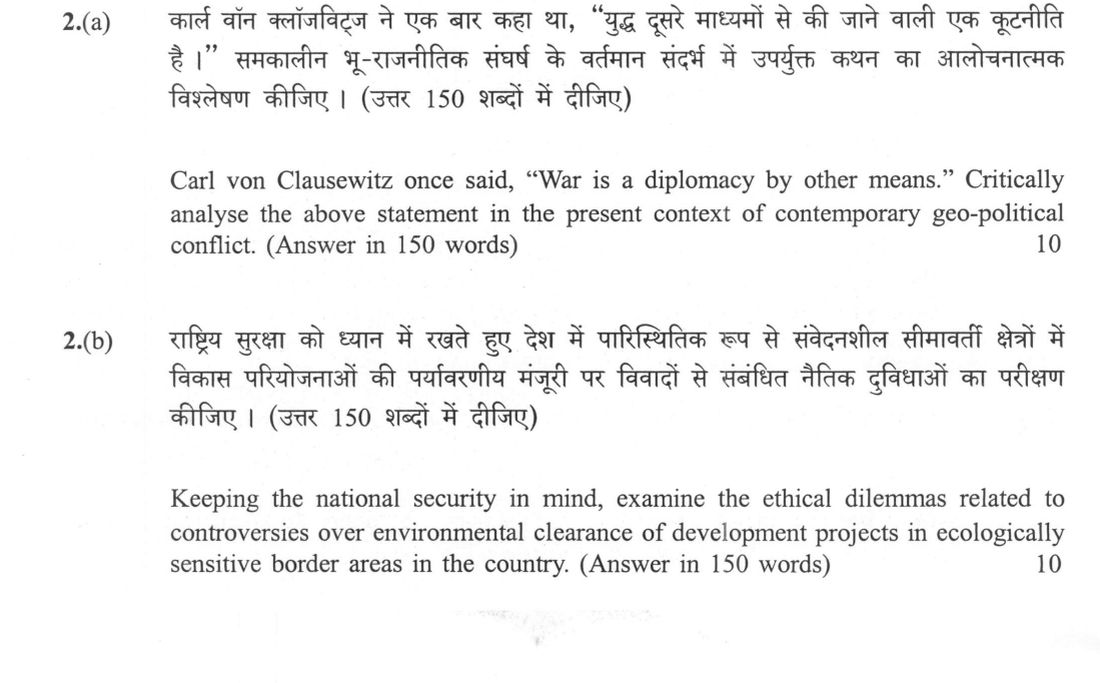
Carl von Clausewitz once said, "War is a diplomacy by other means." Critically analyse the above statement in the present context of contemporary geo-political conflict. (Answer in 150 words) 10 marks
Keeping the national security in mind, examine the ethical dilemmas related to controversies over environmental clearance of development projects in ecologically sensitive border areas in the country. (Answer in 150 words) 10 marks
हिंदी में प्रश्न पढ़ें
कार्ल वॉन क्लॉज़विट्ज़ ने एक बार कहा था, "युद्ध दूसरे माध्यमों से की जाने वाली एक कूटनीति है।" समकालीन भू-राजनीतिक संघर्ष के वर्तमान संदर्भ में उपर्युक्त कथन का आलोचनात्मक विश्लेषण कीजिए। (उत्तर 150 शब्दों में दीजिए) 10 marks
राष्ट्रीय सुरक्षा को ध्यान में रखते हुए देश में पारिस्थितिक रूप से संवेदनशील सीमावर्ती क्षेत्रों में विकास परियोजनाओं की पर्यावरणीय मंजूरी पर विवादों से संबंधित नैतिक दुविधाओं का परीक्षण कीजिए। (उत्तर 150 शब्दों में दीजिए) 10 marks
Model answer
Written by UPSC Answer Check against this question's marking rubric, to the 150-word length. UPSC does not publish answers for Mains — this is one way to score well, not an official key.
(a) Clausewitzian War in Contemporary Geopolitics Clausewitz conceived war as a rational instrument linking the trinity of government, military, and people. In contemporary geopolitics, nuclear deterrence, cyber warfare, and economic sanctions have transformed this continuum, turning total war from a diplomatic extension into an existential hazard. While the Russia-Ukraine war reflects military force replacing failed diplomacy, the India-China LAC standoffs illustrate military brinkmanship substituting for diplomatic breakthroughs. Thus, while military coercion remains wedded to statecraft, modern catastrophic risks make war a dangerous breakdown of diplomacy rather than its routine continuation.
(b) National Security vs. Ecological Ethics in Border Areas Strategic projects like the Char Dham highway, Zoji-La tunnel, and Arunachal frontier roads create an ethical clash between the Hobbesian imperative of national security as the supreme public good and the Rio Principles of intergenerational equity and nature's rights. Fast-tracking clearances under Environment Protection Act provisions exposes the institutional friction between the Ministry of Defence’s operational urgency and MoEFCC’s precautionary principle. As evidenced in NGT scrutiny over the Subansiri and Teesta-III projects, bypassing cumulative impact assessments in seismic Himalayan zones creates moral hazard, necessitating green engineering over unmitigated clearance.
What "Critically analyse" is asking you to do
Break the subject into its working parts and show how they act on each other. The marks are in the interconnections — which factor drives which, and what the resulting structure explains — not in the inventory of factors. “Critically” is not a section added at the end: name the yardstick you are judging by — the evidence, the stated objective, a constitutional principle, a rival explanation — and let a verdict close each part of the body. Where the question quotes a claim, that verdict must land on the claim itself, accepted, qualified or rejected, and not on the theme in general.
Structure that answers it
Define the whole → separate it into its parts → show which part drives which → what that interaction produces → what the structure implies
Where marks are lost
Merits in one paragraph, demerits in the next, and a conclusion calling for a balanced and holistic approach. That is a survey with the judgement left out and it holds the answer in the middle band. The opposite error is reading “critically” as permission to attack — and with the odd pairings, critically describe or critically explain, the exposition still carries most of the marks, the judgement being a layer on it rather than a substitute for it.
How this answer will be evaluated
Approach
Framework: GS4 Ethical Dilemma & Governance Framework. (a) analyse: intro > causes > effects > stakeholders/linkages > way forward | (b) examine: intro > how/why with reasoning > evidence > conclusion Full marks: Precise, well-structured, with specific examples and critical analysis
Key points expected
- Define 'war as diplomacy by other means'
- Link to contemporary geo-political conflicts
- Critically evaluate the statement's validity
- Provide specific examples of modern conflicts
- Identify ethical dilemmas in environmental clearance
- Focus on ecologically sensitive border areas
- Consider national security implications
- Discuss controversies and their ethical dimensions
Evaluation rubric
Each sub-part is marked on its own, against the marks and word limit printed on the paper.
- (a) Critical analysis of Clausewitz's quote in the context of contemporary geo-political conflict. 10 marks · 150 words
analyse— intro → causes → effects → stakeholders/linkages → way forward
Must cover
- Define 'war as diplomacy by other means'
- Link to contemporary geo-political conflicts
- Critically evaluate the statement's validity
- Provide specific examples of modern conflicts
Loses marks
- Generic discussion of war without specific examples
- Ignoring the 'critical' aspect of the command word
- Failing to link to 'contemporary' context
Earns more
- Mention specific contemporary conflicts (e.g., Ukraine, Middle East)
- Reference modern warfare concepts (cyber, economic)
- Discuss the role of international organizations
- Mention the concept of 'total war'
Extra mark
- Reference specific Clausewitz's work 'On War'
- Mention specific diplomatic failures leading to war
- (b) Examination of ethical dilemmas in environmental clearance for border area projects. 10 marks · 150 words
examine— intro → how/why with reasoning → evidence → conclusion
Must cover
- Identify ethical dilemmas in environmental clearance
- Focus on ecologically sensitive border areas
- Consider national security implications
- Discuss controversies and their ethical dimensions
Loses marks
- Generic discussion of environmental issues without border focus
- Ignoring the 'ethical dilemmas' aspect
- Failing to consider 'national security' context
Earns more
- Mention specific border areas (e.g., Himalayan, Northeast)
- Reference specific environmental laws (e.g., EIA Act)
- Discuss stakeholder conflicts (military vs. environmentalists)
- Mention specific projects (e.g., roads, dams)
Extra mark
- Reference specific environmental clearance cases
- Mention specific ecological zones (e.g., Western Ghats)
Practice this exact question
Write your answer and it is marked point by point against the model answer above — what you covered, what you missed, what you got wrong.
Evaluate my answer →More from General Studies 2025 GS Paper IV
- Q1 (a) In the present digital age, social media has revolutionised our way of communication…
- Q2 (a) Carl von Clausewitz once said, "War is a diplomacy by other means." Critically analys…
- Q3 Given below are three quotations of great thinkers. What do each of these quotations conv…
- Q4 (a) "For any kind of social re-engineering by successfully implementing welfare schemes,…
- Q5 (a) "One who is devoted to one's duty attains highest perfection in life." Analyse this s…