GS Paper II — Q1
"The most significant achievement of modern law in India is the constitutionalization of environmental problems by the Supreme…
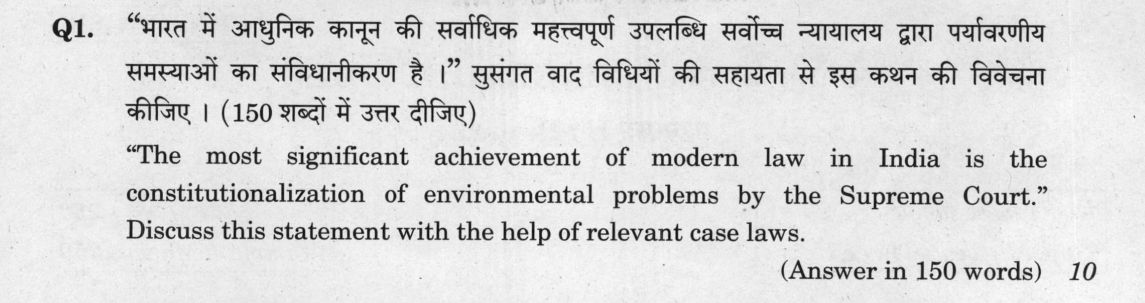
"The most significant achievement of modern law in India is the constitutionalization of environmental problems by the Supreme Court." Discuss this statement with the help of relevant case laws. (Answer in 150 words) 10 marks
हिंदी में प्रश्न पढ़ें
"भारत में आधुनिक कानून की सर्वाधिक महत्वपूर्ण उपलब्धि सर्वोच्च न्यायालय द्वारा पर्यावरणीय समस्याओं का संविधानीकरण है।" सुसंगत वाद विधियों की सहायता से इस कथन की विवेचना कीजिए। (150 शब्दों में उत्तर दीजिए)
Model answer
Written by UPSC Answer Check against this question's marking rubric, to the 150-word length. UPSC does not publish answers for Mains — this is one way to score well, not an official key.
The Supreme Court has profoundly shaped modern Indian law by expanding Article 21 (Right to Life) to encompass the right to a clean environment, utilizing Public Interest Litigation (PIL) to address severe enforcement gaps in the Environment (Protection) Act, 1986.
Through judicial innovation, the Court embedded principles of sustainable development and the "Polluter Pays" doctrine into constitutional jurisprudence. Landmark interventions include the M.C. Mehta cases (establishing absolute liability in the Oleum Gas Leak case and curbing Ganga pollution) and the Indian Council for Enviro-Legal Action case. Furthermore, in T.N. Godavarman, the Court instituted continuous mandamus to oversee forest conservation.
However, viewing this as an unmixed achievement reveals significant limitations. Heavy reliance on the judiciary underscores systemic executive inertia and statutory regulatory failure. Moreover, courts face institutional handicaps in technical policy-making, resulting in persistent implementation challenges for judicial orders.
Moving forward, judicial constitutionalization must be matched by proactive executive enforcement, strengthened regulatory institutions, and participatory legislative reforms.
What "Discuss" is asking you to do
Lay the issue out from more than one side — how it arose, what is claimed for it, what is held against it, and where it now stands. UPSC attaches discuss to broad topics with several live dimensions, so coverage of the dimensions earns more than the strength of your opinion.
Structure that answers it
Set the issue up → the case as it is made → the case against → the dimension both sides leave out → where the balance now lies
Where marks are lost
Listing facts with no thread between them, or arguing one side throughout and calling it a discussion.
How this answer will be evaluated
Approach
Framework: GS2 Paper 2 (Governance, Constitution, Judiciary). discuss: intro > 3-4 dimensions > example > balanced close Full marks: Precise legal analysis with 2+ landmark cases and clear constitutional link.
Key points expected
- Define 'constitutionalization' of environmental problems
- Cite specific Supreme Court judgments (e.g., M.C. Mehta, Vellore)
- Explain the shift from statutory to constitutional rights
- Provide a balanced conclusion on the achievement
Evaluation rubric
Each sub-part is marked on its own, against the marks and word limit printed on the paper.
- The answer Evaluate the Supreme Court's role in constitutionalizing environmental issues via case law. 10 marks · 150 words
discuss— intro → 3-4 dimensions → example → balanced close
Must cover
- Define 'constitutionalization' of environmental problems
- Cite specific Supreme Court judgments (e.g., M.C. Mehta, Vellore)
- Explain the shift from statutory to constitutional rights
- Provide a balanced conclusion on the achievement
Loses marks
- Reciting Articles without linking to case law
- Focusing on environmental facts rather than legal evolution
- Failing to address the 'Supreme Court' aspect specifically
Earns more
- Mention Article 21 (Right to Life) expansion
- Reference Public Interest Litigation (PIL) mechanism
- Mention Article 48-A or 51-A(g)
- Reference the Precautionary Principle or Polluter Pays
Extra mark
- Cite specific dates of landmark judgments
- Reference Law Commission recommendations on environment
Practice this exact question
Write your answer and it is marked point by point against the model answer above — what you covered, what you missed, what you got wrong.
Evaluate my answer →More from General Studies 2022 GS Paper II
- Q1 "The most significant achievement of modern law in India is the constitutionalization of…
- Q2 "Right of movement and residence throughout the territory of India are freely available t…
- Q3 To what extent, in your opinion, has the decentralisation of power in India changed the g…
- Q4 Discuss the role of the Vice-President of India as the Chairman of the Rajya Sabha. (Answ…