GS Paper II — Q18
The Right of Children to Free and Compulsory Education Act, 2009 remains inadequate in promoting incentive-based system for…
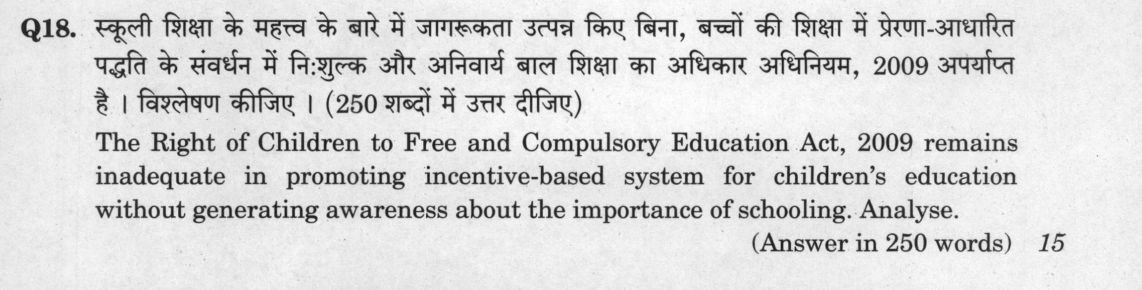
The Right of Children to Free and Compulsory Education Act, 2009 remains inadequate in promoting incentive-based system for children's education without generating awareness about the importance of schooling. Analyse. (Answer in 250 words) 15 marks
हिंदी में प्रश्न पढ़ें
स्कूली शिक्षा के महत्व के बारे में जागरूकता उत्पन्न किए बिना, बच्चों की शिक्षा में प्रेरणा-आधारित पद्धति के संवर्धन में निःशुल्क और अनिवार्य बाल शिक्षा का अधिकार अधिनियम, 2009 अपर्याप्त है। विश्लेषण कीजिए। (250 शब्दों में उत्तर दीजिए)
Model answer
Written by UPSC Answer Check against this question's marking rubric, to the 250-word length. UPSC does not publish answers for Mains — this is one way to score well, not an official key.
The Right of Children to Free and Compulsory Education (RTE) Act, 2009, operationalising Article 21A, achieved near-universal enrolment. However, it predominantly targeted supply-side provisioning, remaining inadequate in cultivating demand-side behavioural incentives for regular attendance and quality learning outcomes.
Supply Mandates versus Demand-Side Motivation The Act heavily prioritised structural inputs—such as pupil-teacher ratios, infrastructure norms, and the 25% EWS quota under Section 12(1)(c). This created an asymmetry with demand-side motivation. Material incentives like PM-POSHAN (Mid-Day Meals), free uniforms, and scholarships often function merely as safety nets rather than catalysts for schooling. Without parental awareness of the long-term returns on education, especially among marginalised communities, these financial incentives fail to curb dropouts or drive learning engagement.
Perverse Incentives and Accountability Deficit The statutory No-Detention Policy (prior to its 2019 amendment) acted as a perverse disincentive. In the absence of public awareness drives regarding foundational literacy and numeracy, automatic promotion diluted accountability among teachers, parents, and students, detaching grade progression from actual competency acquisition.
Bridging Incentives and Awareness State-level initiatives highlight the necessity of this linkage. Bihar’s Mukhyamantri Balika Cycle Yojana succeeded because it integrated a physical incentive with community mobilization for girls' mobility and education. Conversely, Delhi’s Chunauti programme targeted learning-level transitions by combining academic grouping with active parent-teacher engagement.
Way Forward To realize the RTE's vision, educational policy must incorporate behavioural economics. Deploying information 'nudges', revitalising School Management Committees (SMCs), and mobilizing mothers' collectives can build community ownership, ensuring that incentive-based systems translate effectively into sustained retention and measurable learning outcomes.
What "Analyse" is asking you to do
Break the subject into its working parts and show how they act on each other. The marks are in the interconnections — which factor drives which, and what the resulting structure explains — not in the inventory of factors.
Structure that answers it
Define the whole → separate it into its parts → show which part drives which → what that interaction produces → what the structure implies
Where marks are lost
A flat list of causes with no account of which drives which. An answer of neatly separated headings, each self-contained, scores as description.
How this answer will be evaluated
Approach
Framework: GS2 Governance & Social Justice. analyse: intro > causes > effects > stakeholders/linkages > way forward Full marks: Sharp critique of the Act's structural gap, linking incentives to awareness with specific reforms.
Key points expected
- Identify the gap between legal mandate and social awareness
- Analyze the absence of incentive-based mechanisms in the Act
- Explain the impact of low awareness on enrollment/retention
- Propose realistic reforms to bridge the incentive-awareness gap
Evaluation rubric
Each sub-part is marked on its own, against the marks and word limit printed on the paper.
- The answer Critique the RTE Act's failure to link incentives with awareness generation. 15 marks · 250 words
analyse— intro → causes → effects → stakeholders/linkages → way forward
Must cover
- Identify the gap between legal mandate and social awareness
- Analyze the absence of incentive-based mechanisms in the Act
- Explain the impact of low awareness on enrollment/retention
- Propose realistic reforms to bridge the incentive-awareness gap
Loses marks
- Reciting RTE sections without analytical critique
- Focusing only on infrastructure, ignoring the 'incentive' aspect
- Ending without a concrete reform or way forward
Earns more
- Reference to specific RTE provisions (e.g., Section 12, 13)
- Mention of government schemes (e.g., PM-SHRI, Samagra Shiksha)
- Discussion of 'schooling' vs 'education' distinction
- Linkage to constitutional morality (Article 21A)
Extra mark
- Citation of 2nd ARC or Law Commission recommendations
- Reference to a specific Supreme Court judgment on RTE
Practice this exact question
Write your answer and it is marked point by point against the model answer above — what you covered, what you missed, what you got wrong.
Evaluate my answer →More from General Studies 2022 GS Paper II
- Q15 Discuss the role of the Election Commission of India in the light of the evolution of the…
- Q16 Besides the welfare schemes, India needs deft management of inflation and unemployment to…
- Q17 Do you agree with the view that increasing dependence on donor agencies for development r…
- Q18 The Right of Children to Free and Compulsory Education Act, 2009 remains inadequate in pr…
- Q19 How will I2U2 (India, Israel, UAE and USA) grouping transform India's position in global…
- Q20 'Clean energy is the order of the day.' Describe briefly India's changing policy towards…