GS Paper II — Q17
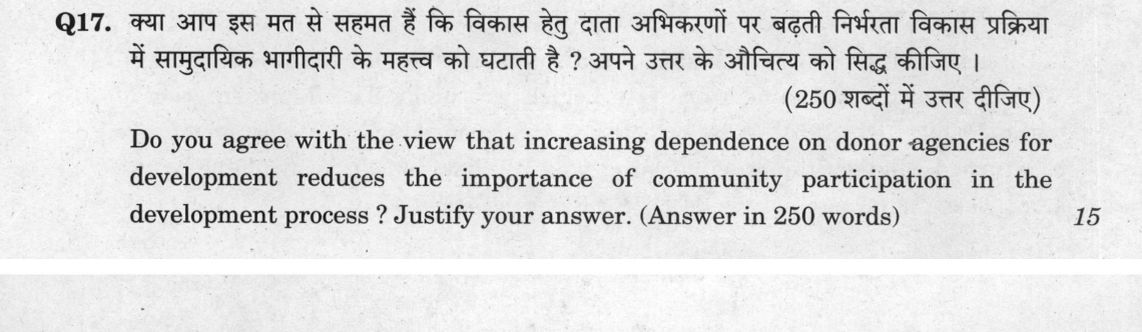
Do you agree with the view that increasing dependence on donor agencies for development reduces the importance of community…
Do you agree with the view that increasing dependence on donor agencies for development reduces the importance of community participation in the development process ? Justify your answer. (Answer in 250 words) 15 marks
हिंदी में प्रश्न पढ़ें
क्या आप इस मत से सहमत हैं कि विकास हेतु दाता अभिकरणों पर बढ़ती निर्भरता विकास प्रक्रिया में सामुदायिक भागीदारी के महत्व को घटाती है ? अपने उत्तर के औचित्य को सिद्ध कीजिए । (250 शब्दों में उत्तर दीजिए)
Model answer
Written by UPSC Answer Check against this question's marking rubric, to the 250-word length. UPSC does not publish answers for Mains — this is one way to score well, not an official key.
I largely agree that increasing dependence on donor agencies can reduce community participation, but the outcome is not automatic; it depends on aid design.
When development is financed through conditional grants, donors may impose policy prescriptions—fiscal consolidation, market liberalisation, sector-specific targets—that bypass local priorities. Such conditionality weakens ownership because communities are asked to implement externally defined projects rather than shape them. Top-down implementation, with funds channelled through state agencies or large NGOs, can crowd out Gram Sabhas and local institutions, reducing accountability to beneficiaries. In India, externally financed watershed or livelihood projects sometimes predefine beneficiary criteria, limiting Gram Sabha deliberation and diluting ownership. The aid-effectiveness debate, reflected in the Paris Declaration and Busan Partnership, recognises that aid undermines participation when it bypasses national and local systems, creates parallel reporting structures, and rewards compliance over local deliberation.
However, donor dependence does not inevitably erode participation. Donor-supported community-driven development, such as World Bank CDD models, can strengthen local voice when funds are devolved and decisions are made in Gram Sabhas under Article 243A; India’s Panchayati Raj-linked rural development schemes show the same logic when local bodies control planning. NGO-mediated projects can also build capacity, though they may substitute professional advocacy for grassroots deliberation.
Thus, the danger lies not in external resources but in their design. Participation is preserved when donors align with local priorities, use existing institutions, ensure transparent fund flows, and allow communities to monitor outcomes. In such conditions, donor support can complement, rather than displace, community agency.
What "Justify" is asking you to do
Defend a position with reasons that carry evidence, and show why the contrary view does not hold. Where the stem runs as a question and asks you to justify your answer, the position is yours to choose and the marks lie wholly in the defence.
Structure that answers it
Position stated plainly → reason 1 with evidence → reason 2 with evidence → strongest objection, met → position restated as qualified
Where marks are lost
Reasons stated and none of them evidenced. The other standard loss is fence-sitting — an answer that finds merit on both sides and commits to neither has justified nothing.
How this answer will be evaluated
Approach
Framework: GS2 Governance & Social Justice. justify: claim > 3-4 reasons > evidence > conclusion Full marks: Clear stance with 3-4 strong, distinct arguments and a specific reform/conclusion.
Key points expected
- Explicitly state agreement or disagreement with the view
- Explain the mechanism of how donor dependence affects participation
- Provide 3-4 distinct reasons supporting the chosen position
- Conclude with a balanced judgment or way forward
Evaluation rubric
Each sub-part is marked on its own, against the marks and word limit printed on the paper.
- The answer State a clear position on the donor-dependence vs. community-participation debate and support it with 3-4 reasoned arguments. 15 marks · 250 words
justify— claim → 3-4 reasons → evidence → conclusion
Must cover
- Explicitly state agreement or disagreement with the view
- Explain the mechanism of how donor dependence affects participation
- Provide 3-4 distinct reasons supporting the chosen position
- Conclude with a balanced judgment or way forward
Loses marks
- Reciting general development theories without application
- Failing to take a clear stance (ambiguity)
- Ending without a reform or balanced conclusion
Earns more
- Mention specific donor agency types (bilateral/multilateral)
- Reference specific development schemes or sectors
- Discuss the concept of 'aid dependency' or 'conditionality'
- Highlight the role of local self-governments (Panchayati Raj)
Extra mark
- Cite a specific Supreme Court judgment on public participation
- Reference a specific 2nd ARC or Law Commission report
Practice this exact question
Write your answer and it is marked point by point against the model answer above — what you covered, what you missed, what you got wrong.
Evaluate my answer →More from General Studies 2022 GS Paper II
- Q14 Critically examine the procedures through which the Presidents of India and France are el…
- Q15 Discuss the role of the Election Commission of India in the light of the evolution of the…
- Q16 Besides the welfare schemes, India needs deft management of inflation and unemployment to…
- Q17 Do you agree with the view that increasing dependence on donor agencies for development r…
- Q18 The Right of Children to Free and Compulsory Education Act, 2009 remains inadequate in pr…
- Q19 How will I2U2 (India, Israel, UAE and USA) grouping transform India's position in global…
- Q20 'Clean energy is the order of the day.' Describe briefly India's changing policy towards…