GS Paper II — Q11
Discuss the procedures to decide the disputes arising out of the election of a Member of the Parliament or State Legislature…
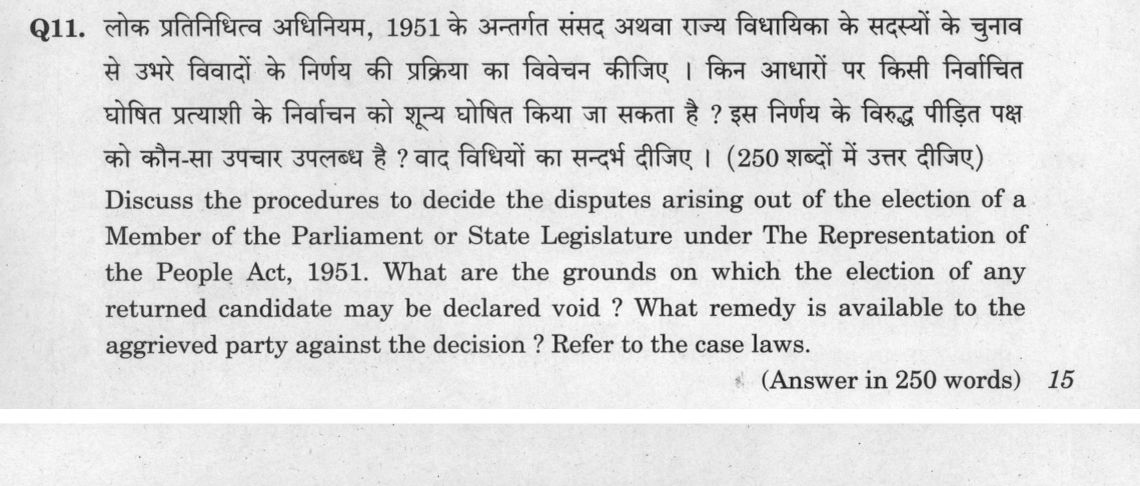
Discuss the procedures to decide the disputes arising out of the election of a Member of the Parliament or State Legislature under The Representation of the People Act, 1951. What are the grounds on which the election of any returned candidate may be declared void ? What remedy is available to the aggrieved party against the decision ? Refer to the case laws. (Answer in 250 words) 15 marks
हिंदी में प्रश्न पढ़ें
लोक प्रतिनिधित्व अधिनियम, 1951 के अंतर्गत संसद अथवा राज्य विधानिका के सदस्यों के चुनाव से उभरे विवादों के निर्णय की प्रक्रिया का विवेचन कीजिए। किन आधारों पर किसी निर्वाचित घोषित प्रत्याशी के निर्वाचन को शून्य घोषित किया जा सकता है ? इस निर्णय के विरुद्ध पीड़ित पक्ष को कौन-सा उपचार उपलब्ध है ? वाद विधियों का संदर्भ दीजिए। (250 शब्दों में उत्तर दीजिए)
Model answer
Written by UPSC Answer Check against this question's marking rubric, to the 250-word length. UPSC does not publish answers for Mains — this is one way to score well, not an official key.
Disputes over election of an MP or MLA are decided by the High Court under ss.80-81 of the RPA, 1951. An election petition, in prescribed form, with security deposit and court fee, must be filed within 45 days of the date of election. It is tried by a single judge, who has civil-court powers under the CPC, including discovery, inspection and summoning witnesses. Ponnuswami v. Returning Officer (1952) affirmed High Court jurisdiction.
Under ss.100/101, a returned candidate’s election may be void if he was disqualified under the Constitution or the Government of Union Territories Act, 1963; or if a corrupt practice was committed by him, his election agent, or any other person with his or the agent’s consent. It may also be void if a corrupt practice by another candidate or agent materially affected the result, or if the result was materially affected by improper acceptance of nomination, or improper rejection where it amounts to substantial non-compliance, corrupt practice of any other agent in the returned candidate’s interest, improper reception, refusal or rejection of any vote, reception of a void vote, or substantial non-compliance with the Act/rules. Kultar Singh v. Mukhtiar Singh (1965) interpreted corrupt practices; Mohinder Singh Gill v. CEC (1978) clarified the scope of election petitions.
Against the High Court’s decision, the aggrieved party may appeal to the Supreme Court under s.116A within 30 days. Its decision is final; Articles 226 and 32 cannot disturb it. This time-bound, specialised procedure protects electoral integrity by confining challenges to defined legal grounds.
What "Discuss" is asking you to do
Lay the issue out from more than one side — how it arose, what is claimed for it, what is held against it, and where it now stands. UPSC attaches discuss to broad topics with several live dimensions, so coverage of the dimensions earns more than the strength of your opinion.
Structure that answers it
Set the issue up → the case as it is made → the case against → the dimension both sides leave out → where the balance now lies
Where marks are lost
Listing facts with no thread between them, or arguing one side throughout and calling it a discussion.
How this answer will be evaluated
Approach
Framework: GS2 Paper 2: Constitutional & Legal Framework. discuss: intro > 3-4 dimensions > example > balanced close Full marks: Accurate procedure (45 days, HC as Tribunal), clear grounds (corrupt practices), and correct remedy (SC appeal) with case law.
Key points expected
- Procedure: Filing within 45 days of result (Sec 86)
- Procedure: Trial by High Court as Election Tribunal (Sec 96)
- Grounds: Corrupt practices or material irregularities (Sec 87)
- Remedy: Appeal to Supreme Court (Sec 100)
Evaluation rubric
Each sub-part is marked on its own, against the marks and word limit printed on the paper.
- The answer Procedures for election disputes, grounds for voiding, and available remedies under RPA 1951. · 250 words
discuss— intro → 3-4 dimensions → example → balanced close
Must cover
- Procedure: Filing within 45 days of result (Sec 86)
- Procedure: Trial by High Court as Election Tribunal (Sec 96)
- Grounds: Corrupt practices or material irregularities (Sec 87)
- Remedy: Appeal to Supreme Court (Sec 100)
Loses marks
- Reciting Section numbers without explaining the procedure
- Confusing the Election Commission's role with the High Court's
- Failing to mention the specific remedy (Appeal to SC)
Earns more
- Mention of 'Corrupt Practices' (Sec 123) as a ground
- Distinction between material and non-material irregularity
- Reference to the 'Election Tribunal' status of the High Court
- Mention of the 45-day limitation period
Extra mark
- Citing a specific landmark case law (e.g., Raju Ramachandran v. K. Rajagopal)
- Reference to the 2nd ARC or Law Commission on election reforms
Practice this exact question
Write your answer and it is marked point by point against the model answer above — what you covered, what you missed, what you got wrong.
Evaluate my answer →More from General Studies 2022 GS Paper II
- Q8 Reforming the government delivery system through the Direct Benefit Transfer Scheme is a…
- Q9 'India is an age-old friend of Sri Lanka.' Discuss India's role in the recent crisis in S…
- Q10 Do you think that BIMSTEC is a parallel organisation like the SAARC ? What are the simila…
- Q11 Discuss the procedures to decide the disputes arising out of the election of a Member of…
- Q12 Discuss the essential conditions for exercise of the legislative powers by the Governor.…
- Q13 "While the national political parties in India favour centralisation, the regional partie…
- Q14 Critically examine the procedures through which the Presidents of India and France are el…