GS Paper II — Q12
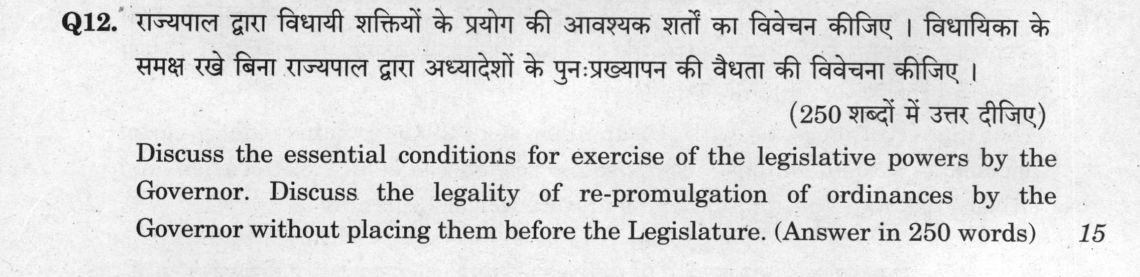
Discuss the essential conditions for exercise of the legislative powers by the Governor. Discuss the legality of re-promulgation…
Discuss the essential conditions for exercise of the legislative powers by the Governor. Discuss the legality of re-promulgation of ordinances by the Governor without placing them before the Legislature. (Answer in 250 words) 15 marks
हिंदी में प्रश्न पढ़ें
राज्यपाल द्वारा विधायी शक्तियों के प्रयोग की आवश्यक शर्तों का विवेचन कीजिए । विधायिका के समक्ष रखे बिना राज्यपाल द्वारा अध्यादेशों के पुनःप्रख्यापन की वैधता की विवेचना कीजिए । (250 शब्दों में उत्तर दीजिए)
Model answer
Written by UPSC Answer Check against this question's marking rubric, to the 250-word length. UPSC does not publish answers for Mains — this is one way to score well, not an official key.
Under Article 213 of the Constitution, the Governor is vested with the extraordinary legislative power to promulgate ordinances. This power is not a parallel stream of law-making but an emergency mechanism subject to specific constitutional conditions:
Essential Conditions under Article 213 First, the power can be exercised only when the State Legislature (or either House in a bicameral legislature) is not in session. Second, the Governor must be satisfied that circumstances exist rendering it necessary to take immediate action. Third, the Governor cannot promulgate certain ordinances without prior presidential instructions, particularly if a Bill containing the same provisions would have required President’s assent. Finally, every ordinance must be laid before the State Legislature upon reassembly and ceases to operate after six weeks, or earlier if disapproved by the legislature.
Legality of Re-promulgation Re-promulgating ordinances without placing them before the legislature subverts parliamentary democracy. In D.C. Wadhwa v. State of Bihar (1987), the Supreme Court held that mechanical re-promulgation without legislative scrutiny is a colourable exercise of power and a subversion of the constitutional process.
A seven-judge Constitution Bench in Krishna Kumar Singh v. State of Bihar (2017) reinforced that re-promulgation constitutes a "fraud on the Constitution." The Court held that while the Governor’s subjective satisfaction is not lightly interfered with, the exercise of ordinance power and any pattern of re-promulgation without tabling before the legislature is subject to judicial review.
Way Forward Though the 44th Constitutional Amendment Bill (1978) proposed statutory time limits against repeated re-promulgations (which ultimately lapsed), preserving the separation of powers requires self-restraint by the executive and rigorous judicial review to ensure governance by decree does not supplant representative democracy.
What "Discuss" is asking you to do
Lay the issue out from more than one side — how it arose, what is claimed for it, what is held against it, and where it now stands. UPSC attaches discuss to broad topics with several live dimensions, so coverage of the dimensions earns more than the strength of your opinion.
Structure that answers it
Set the issue up → the case as it is made → the case against → the dimension both sides leave out → where the balance now lies
Where marks are lost
Listing facts with no thread between them, or arguing one side throughout and calling it a discussion.
How this answer will be evaluated
Approach
Framework: GS2 Paper 2: Constitutional Law & Governance. discuss: intro > 3-4 dimensions > example > balanced close Full marks: Precise legal conditions and clear judgment on re-promulgation with case law.
Key points expected
- Article 213 conditions (Adjournment, Urgency, Non-existence of law)
- Distinction between 'placing' and 'passing' ordinances
- Legality of re-promulgation without legislative approval
- Judicial view on executive overreach
Evaluation rubric
Each sub-part is marked on its own, against the marks and word limit printed on the paper.
- The answer Conditions for ordinance power and legality of re-promulgation. · 250 words
discuss— intro → 3-4 dimensions → example → balanced close
Must cover
- Article 213 conditions (Adjournment, Urgency, Non-existence of law)
- Distinction between 'placing' and 'passing' ordinances
- Legality of re-promulgation without legislative approval
- Judicial view on executive overreach
Loses marks
- Reciting Article 213 without analysis
- Ignoring the 're-promulgation' aspect
- Confusing ordinance with executive order
Earns more
- Citing Ram Narain v. State of UP
- Citing D.C. Wadhwa v. State of Bihar
- Mentioning 6-week time limit for legislative approval
- Reference to separation of powers
Extra mark
- Citing 13th Law Commission Report
- Mentioning 98th Constitutional Amendment Bill
Practice this exact question
Write your answer and it is marked point by point against the model answer above — what you covered, what you missed, what you got wrong.
Evaluate my answer →More from General Studies 2022 GS Paper II
- Q9 'India is an age-old friend of Sri Lanka.' Discuss India's role in the recent crisis in S…
- Q10 Do you think that BIMSTEC is a parallel organisation like the SAARC ? What are the simila…
- Q11 Discuss the procedures to decide the disputes arising out of the election of a Member of…
- Q12 Discuss the essential conditions for exercise of the legislative powers by the Governor.…
- Q13 "While the national political parties in India favour centralisation, the regional partie…
- Q14 Critically examine the procedures through which the Presidents of India and France are el…
- Q15 Discuss the role of the Election Commission of India in the light of the evolution of the…