GS Paper II — Q2
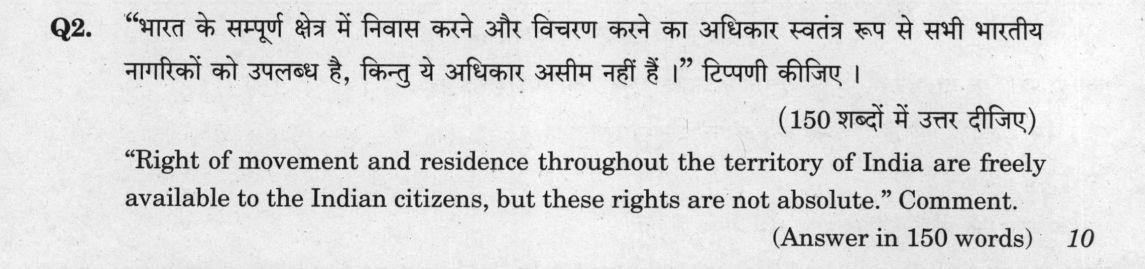
"Right of movement and residence throughout the territory of India are freely available to the Indian citizens, but these rights…
"Right of movement and residence throughout the territory of India are freely available to the Indian citizens, but these rights are not absolute." Comment. (Answer in 150 words) 10 marks
हिंदी में प्रश्न पढ़ें
"भारत के सम्पूर्ण क्षेत्र में निवास करने और विचरण करने का अधिकार स्वतंत्र रूप से सभी भारतीय नागरिकों को उपलब्ध है, किन्तु ये अधिकार असीम नहीं हैं।" टिप्पणी कीजिए। (150 शब्दों में उत्तर दीजिए)
Model answer
Written by UPSC Answer Check against this question's marking rubric, to the 150-word length. UPSC does not publish answers for Mains — this is one way to score well, not an official key.
Articles 19(1)(d) and 19(1)(e) guarantee citizens the right to move freely and reside anywhere within India, promoting national integration. However, these rights are qualified, not absolute.
Article 19(5) empowers the State to enforce reasonable restrictions on two distinct grounds: the interest of the general public and the protection of Scheduled Tribes.
Public Order, Health, and Safety: Movement can be curtailed to manage emergencies, as demonstrated during COVID-19 lockdowns, or regulated on grounds of public health and morality (State of U.P. v. Kaushalya Devi). Furthermore, the right to residence does not sanction unlawful encroachments on public lands (Olga Tellis case) and remains subject to civic planning (Shantistar Builders case).
Tribal Protection: Mechanisms like the Inner Line Permit (ILP) in North-Eastern states restrict outside entry and settlement to safeguard indigenous cultures and resources, a balance evident in CAA/NRC debates.
Ultimately, qualifying these rights maintains a vital constitutional equilibrium between individual liberty and collective welfare.
What "Comment" is asking you to do
Take a position on the statement and support it. Comment usually attaches to a quoted line in the short slots, so the reasoning must be compressed — an opening view, a few load-bearing reasons, and the limit of the claim.
Structure that answers it
Unpack what the statement asserts → your stance → two or three supporting reasons → the qualification that limits it
Where marks are lost
Neutral summary; a comment without a stance has not answered. Equally costly is accepting the quoted line wholesale and never testing where it fails.
How this answer will be evaluated
Approach
Framework: GS2 Paper 2 (Polity & Governance). comment: context > arguments both sides > judgment > close Full marks: Precise legal analysis of Art 19(1)(e)/(f) with specific examples of restrictions and constitutional context.
Key points expected
- Cite Article 19(1)(e) and (f) as the source of rights
- Explain 'reasonable restrictions' under Article 19(5)
- Distinguish between 'residence' and 'settlement' (Article 19(1)(f))
- Provide a specific example of a restriction (e.g., tribal areas, security)
Evaluation rubric
Each sub-part is marked on its own, against the marks and word limit printed on the paper.
- The answer Contextualize Article 19(1)(e) and (f) and justify the constitutional limits on these rights. 10 marks · 150 words
comment— context → arguments both sides → judgment → close
Must cover
- Cite Article 19(1)(e) and (f) as the source of rights
- Explain 'reasonable restrictions' under Article 19(5)
- Distinguish between 'residence' and 'settlement' (Article 19(1)(f))
- Provide a specific example of a restriction (e.g., tribal areas, security)
Loses marks
- Reciting the text of Article 19 without analysis
- Treating the rights as absolute without mentioning restrictions
- Confusing 'movement' with 'residence' or 'settlement'
Earns more
- Mention the 44th Amendment (1978) changes to Article 19
- Reference the 10th Schedule (Anti-defection) or Article 31A/B/C
- Discuss the 'public order' or 'morality' grounds for restriction
- Mention the 14th Amendment (1962) regarding tribal areas
Extra mark
- Cite a specific Supreme Court judgment (e.g., A.K. Gopalan or Maneka Gandhi)
- Reference the 2nd ARC or Law Commission recommendations on internal migration
Practice this exact question
Write your answer and it is marked point by point against the model answer above — what you covered, what you missed, what you got wrong.
Evaluate my answer →More from General Studies 2022 GS Paper II
- Q1 "The most significant achievement of modern law in India is the constitutionalization of…
- Q2 "Right of movement and residence throughout the territory of India are freely available t…
- Q3 To what extent, in your opinion, has the decentralisation of power in India changed the g…
- Q4 Discuss the role of the Vice-President of India as the Chairman of the Rajya Sabha. (Answ…
- Q5 Discuss the role of the National Commission for Backward Classes in the wake of its trans…