GS Paper II — Q7
The Rights of Persons with Disabilities Act, 2016 remains only a legal document without intense sensitisation of government…
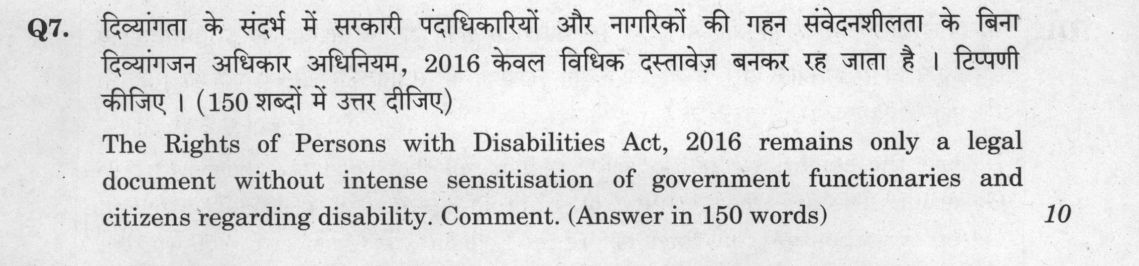
The Rights of Persons with Disabilities Act, 2016 remains only a legal document without intense sensitisation of government functionaries and citizens regarding disability. Comment. (Answer in 150 words) 10 marks
हिंदी में प्रश्न पढ़ें
दिव्यांगता के संदर्भ में सरकारी पदाधिकारियों और नागरिकों की गहन संवेदनशीलता के बिना दिव्यांगजन अधिकार अधिनियम, 2016 केवल विधिक दस्तावेज बनकर रह जाता है। टिप्पणी कीजिए। (150 शब्दों में उत्तर दीजिए)
Model answer
Written by UPSC Answer Check against this question's marking rubric, to the 150-word length. UPSC does not publish answers for Mains — this is one way to score well, not an official key.
The Rights of Persons with Disabilities (RPwD) Act, 2016 marked a paradigm shift by expanding recognized disabilities from 7 to 21 and establishing a rights-based framework aligned with the UNCRPD. However, without widespread sensitisation, progressive legislation risks remaining a paper tiger.
Attitudinal and Administrative Gaps: Society persistently clings to a pity-charity model rather than a rights-based approach, perpetuating stigma in education, marriage, and employment. Among government functionaries, low disability budgeting (under 2% of scheme outlays), tardy creation of accessible public infrastructure, and under-resourced State Disability Commissioners severely impede implementation.
Citizen and Institutional Deficits: Citizens and employers remain largely unaware of statutory mandates like "reasonable accommodation" and grievance redressal avenues. Simultaneously, governance lacks structural empathy due to the absence of disability etiquette training for bureaucrats, sign language interpreters in courts, and inclusive education modules for schoolteachers.
Way Forward: Translating the Act into ground reality requires mandatory disability audits, community-based rehabilitation, and strengthening District Disability Rehabilitation Centres (DDRCs) to build an inclusive society anchored in empathy rather than mere legal compliance.
What "Comment" is asking you to do
Take a position on the statement and support it. Comment usually attaches to a quoted line in the short slots, so the reasoning must be compressed — an opening view, a few load-bearing reasons, and the limit of the claim.
Structure that answers it
Unpack what the statement asserts → your stance → two or three supporting reasons → the qualification that limits it
Where marks are lost
Neutral summary; a comment without a stance has not answered. Equally costly is accepting the quoted line wholesale and never testing where it fails.
How this answer will be evaluated
Approach
Framework: GS2 Social Justice / Disability Rights. comment: context > arguments both sides > judgment > close Full marks: Clear context, strong arguments both sides, sharp judgment, balanced close
Key points expected
- Context: Act 2016 as legal framework
- Argument: Law is insufficient without sensitization
- Judgment: Sensitization is the real implementation gap
- Close: Balanced view on law vs. social change
Evaluation rubric
Each sub-part is marked on its own, against the marks and word limit printed on the paper.
- The answer Context > arguments both sides > judgment > close 10 marks · 150 words
comment— context → arguments both sides → judgment → close
Must cover
- Context: Act 2016 as legal framework
- Argument: Law is insufficient without sensitization
- Judgment: Sensitization is the real implementation gap
- Close: Balanced view on law vs. social change
Loses marks
- Reciting Act provisions without analysis
- Activist tone without balanced judgment
- Ending without a clear conclusion
Earns more
- Mention of specific sensitization mechanisms
- Reference to implementation challenges
- Balanced view on law's role
- Concrete examples of lack of sensitization
Extra mark
- Cite specific sensitization programs or failures
- Reference to specific government initiatives
Practice this exact question
Write your answer and it is marked point by point against the model answer above — what you covered, what you missed, what you got wrong.
Evaluate my answer →More from General Studies 2022 GS Paper II
- Q4 Discuss the role of the Vice-President of India as the Chairman of the Rajya Sabha. (Answ…
- Q5 Discuss the role of the National Commission for Backward Classes in the wake of its trans…
- Q6 The Gati-Shakti Yojana needs meticulous coordination between the government and the priva…
- Q7 The Rights of Persons with Disabilities Act, 2016 remains only a legal document without i…
- Q8 Reforming the government delivery system through the Direct Benefit Transfer Scheme is a…
- Q9 'India is an age-old friend of Sri Lanka.' Discuss India's role in the recent crisis in S…
- Q10 Do you think that BIMSTEC is a parallel organisation like the SAARC ? What are the simila…