GS Paper II — Q16
Besides the welfare schemes, India needs deft management of inflation and unemployment to serve the poor and the underprivileged…
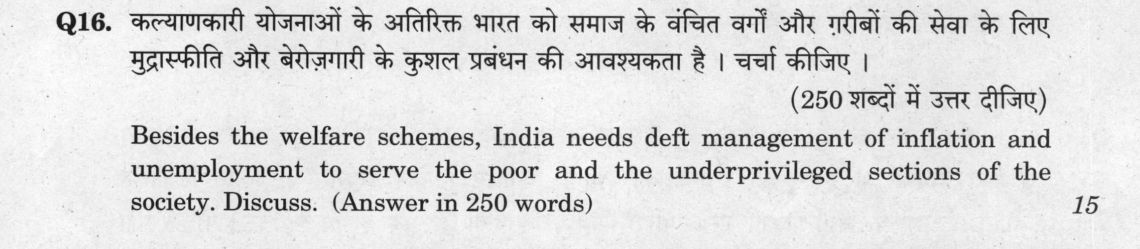
Besides the welfare schemes, India needs deft management of inflation and unemployment to serve the poor and the underprivileged sections of the society. Discuss. (Answer in 250 words) 15 marks
हिंदी में प्रश्न पढ़ें
कल्याणकारी योजनाओं के अतिरिक्त भारत को समाज के वंचित वर्गों और गरीबों की सेवा के लिए मुद्रास्फीति और बेरोजगारी के कुशल प्रबंधन की आवश्यकता है । चर्चा कीजिए । (250 शब्दों में उत्तर दीजिए)
Model answer
Written by UPSC Answer Check against this question's marking rubric, to the 250-word length. UPSC does not publish answers for Mains — this is one way to score well, not an official key.
Welfare interventions like PM Garib Kalyan Anna Yojana (PMGKAY), MGNREGA, and PM-KISAN provide vital safety nets and consumption support. However, they mitigate the symptoms rather than the structural causes of deprivation, which remain intensely tied to macroeconomic variables like inflation and unemployment.
Inflation as a Regressive Tax Inflation disproportionately hurts the poor, who allocate over 45% of their expenditure to essential food items. High Consumer Price Index (CPI) food inflation erodes real household purchasing power, neutralises cash transfers, and forces cutbacks on nutrition, health, and education, thereby deepening multidimensional poverty.
Structural Unemployment and Underemployment Periodic Labour Force Survey (PLFS) trends highlight persistent challenges: high youth unemployment, low female labour force participation, and widespread disguised unemployment in agriculture. The phenomenon of jobless growth limits structural transformation. While public works like MGNREGA act as social shock-absorbers, they cannot substitute for sustainable, productive, and formal employment generation.
The Macroeconomic Nexus and Welfare Limits Welfare primarily provides consumption smoothing, whereas inflation and unemployment management enhance production and real income. In developing economies like India, structural rigidities often limit the classic Phillips Curve trade-off, creating risks of stagflation where elevated cost-push inflation coexists with underemployment. Unchecked price pressures risk triggering wage-price spirals and fiscal stress, ultimately constraining the state’s welfare expenditure capacity.
Way Forward Serving the underprivileged requires synchronising welfare with deft macroeconomic stewardship. The Monetary Policy Committee (MPC) must anchor inflation expectations through flexible inflation targeting, complemented by supply-side food logistics management. Simultaneously, industrial policy through Production Linked Incentive (PLI) schemes, MSME support, and Skill India must drive labour-intensive manufacturing, transitioning vulnerable households from welfare dependence to sustainable economic mobility.
What "Discuss" is asking you to do
Lay the issue out from more than one side — how it arose, what is claimed for it, what is held against it, and where it now stands. UPSC attaches discuss to broad topics with several live dimensions, so coverage of the dimensions earns more than the strength of your opinion.
Structure that answers it
Set the issue up → the case as it is made → the case against → the dimension both sides leave out → where the balance now lies
Where marks are lost
Listing facts with no thread between them, or arguing one side throughout and calling it a discussion.
How this answer will be evaluated
Approach
Framework: GS2 Economic Development. discuss: intro > 3-4 dimensions > example > balanced close Full marks: Clear link between macroeconomics and poverty, specific policy examples, balanced judgment.
Key points expected
- Link inflation to erosion of real wages for the poor
- Link unemployment to loss of livelihood and dignity
- Explain why welfare schemes alone are insufficient
- Suggest policy measures for macroeconomic stability
Evaluation rubric
Each sub-part is marked on its own, against the marks and word limit printed on the paper.
- The answer Analyze the necessity of managing inflation and unemployment for the poor beyond welfare schemes. 15 marks · 250 words
discuss— intro → 3-4 dimensions → example → balanced close
Must cover
- Link inflation to erosion of real wages for the poor
- Link unemployment to loss of livelihood and dignity
- Explain why welfare schemes alone are insufficient
- Suggest policy measures for macroeconomic stability
Loses marks
- Reciting welfare schemes without linking to macroeconomics
- Ignoring the 'poor and underprivileged' focus
- Ending without a reform or way forward
Earns more
- Mention RBI's monetary policy stance
- Reference NITI Aayog or 2nd ARC recommendations
- Cite specific data on inflation/unemployment impact
- Discuss the role of fiscal policy
Extra mark
- Cite a specific Supreme Court judgment on right to work
- Reference a specific NITI Aayog report
Practice this exact question
Write your answer and it is marked point by point against the model answer above — what you covered, what you missed, what you got wrong.
Evaluate my answer →More from General Studies 2022 GS Paper II
- Q13 "While the national political parties in India favour centralisation, the regional partie…
- Q14 Critically examine the procedures through which the Presidents of India and France are el…
- Q15 Discuss the role of the Election Commission of India in the light of the evolution of the…
- Q16 Besides the welfare schemes, India needs deft management of inflation and unemployment to…
- Q17 Do you agree with the view that increasing dependence on donor agencies for development r…
- Q18 The Right of Children to Free and Compulsory Education Act, 2009 remains inadequate in pr…
- Q19 How will I2U2 (India, Israel, UAE and USA) grouping transform India's position in global…