GS Paper III — Q1
Why is Public Private Partnership (PPP) required in infrastructural projects? Examine the role of PPP model in the redevelopment…
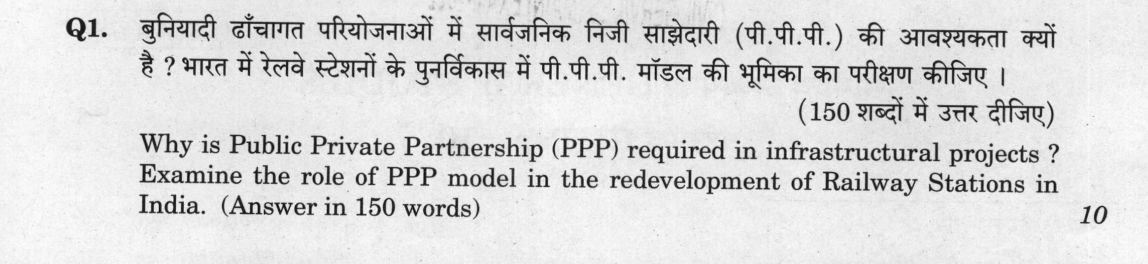
Why is Public Private Partnership (PPP) required in infrastructural projects? Examine the role of PPP model in the redevelopment of Railway Stations in India. (Answer in 150 words) 10 marks
हिंदी में प्रश्न पढ़ें
बुनियादी ढांचागत परियोजनाओं में सार्वजनिक निजी साझेदारी (पी.पी.पी.) की आवश्यकता क्यों है? भारत में रेलवे स्टेशनों के पुनर्विकास में पी.पी.पी. मॉडल की भूमिका का परीक्षण कीजिए। (150 शब्दों में उत्तर दीजिए)
Model answer
Written by UPSC Answer Check against this question's marking rubric, to the 150-word length. UPSC does not publish answers for Mains — this is one way to score well, not an official key.
Public-Private Partnerships (PPPs) are vital to bridge India’s $1.4 trillion infrastructure financing gap under the National Infrastructure Pipeline amid state fiscal constraints. They bring private capital, technological innovation, operational efficiency, and effective risk-sharing across construction, maintenance, and revenue operations.
Role in Railway Station Redevelopment Integrated with PM Gati Shakti and the Amrit Bharat Station Scheme, the Rail Land Development Authority (RLDA) uses PPPs (like DBFOT) to transform stations into city centers through land monetization. Successful models like Rani Kamlapati (Bhopal) and Gandhinagar Capital demonstrate world-class transit hubs created via private investment.
However, an examination reveals key hurdles. Lukewarm private response in projects like Mumbai CSMT highlighted risks around revenue viability, lengthy concession periods, complex land approvals, and project delays. Moreover, balancing commercial real estate exploitation with accessible, affordable passenger amenities remains a key challenge.
While PPP is indispensable for rail modernization, sustained success requires bankable concession agreements, an independent regulatory framework, and user-centric design safeguards.
What "Examine" is asking you to do
Test the proposition the question puts to you and return a finding on how far it holds. Examine stems carry a claim, or ask whether something has happened, and expect evidence weighed both ways before the extent is stated — often with remedial measures attached.
Structure that answers it
Restate the claim as the question frames it → evidence that supports it → evidence that undercuts it → the conditions under which it holds → verdict on how far it stands
Where marks are lost
Stopping at description. An examination has to reach a finding, and “examine with justification” means the extent must be stated, not implied.
How this answer will be evaluated
Approach
Framework: GS3 Economy/Infrastructure: Situation > Analysis > Measures > Assessment. examine: intro > how/why with reasoning > evidence > conclusion Full marks: Links fiscal logic to specific railway examples with policy names.
Key points expected
- Identify fiscal constraints of government in infrastructure
- Explain private sector efficiency and technology transfer
- Detail PPP role in station redevelopment (e.g., commercial space)
- Mention specific examples like New Delhi or Mumbai stations
Evaluation rubric
Each sub-part is marked on its own, against the marks and word limit printed on the paper.
- The answer Justify PPP necessity in infrastructure and analyze its specific application in Indian railway station redevelopment. · 150 words
examine— intro → how/why with reasoning → evidence → conclusion
Must cover
- Identify fiscal constraints of government in infrastructure
- Explain private sector efficiency and technology transfer
- Detail PPP role in station redevelopment (e.g., commercial space)
- Mention specific examples like New Delhi or Mumbai stations
Loses marks
- Generic definition of PPP without infrastructure context
- Ignoring the specific railway station aspect
- Aspirational writing without implementable measures
Earns more
- Reference to 'Amrit Bharat Station Scheme'
- Mention of 'Railway Station Redevelopment' policy
- Discussion of 'Build, Own, Operate' (BOO) model
- Reference to 'National Infrastructure Pipeline' (NIP)
Extra mark
- Specific financial figure for a station project
- Mention of 'Railway Board' guidelines
Practice this exact question
Write your answer and it is marked point by point against the model answer above — what you covered, what you missed, what you got wrong.
Evaluate my answer →More from General Studies 2022 GS Paper III
- Q1 Why is Public Private Partnership (PPP) required in infrastructural projects? Examine the…
- Q2 Is inclusive growth possible under market economy? State the significance of financial in…
- Q3 What are the major challenges of Public Distribution System (PDS) in India? How can it be…
- Q4 Elaborate the scope and significance of the food processing industry in India. (Answer in…