GS Paper III — Q17
Discuss global warming and mention its effects on the global climate. Explain the control measures to bring down the level of…
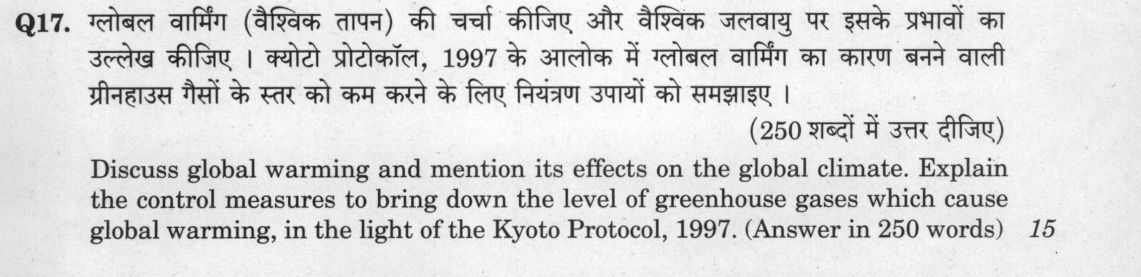
Discuss global warming and mention its effects on the global climate. Explain the control measures to bring down the level of greenhouse gases which cause global warming, in the light of the Kyoto Protocol, 1997. (Answer in 250 words) 15 marks
हिंदी में प्रश्न पढ़ें
ग्लोबल वार्मिंग (वैश्विक तापन) की चर्चा कीजिए और वैश्विक जलवायु पर इसके प्रभावों का उल्लेख कीजिए। क्योटो प्रोटोकॉल, 1997 के आलोक में ग्लोबल वार्मिंग का कारण बनने वाली ग्रीनहाउस गैसों के स्तर को कम करने के लिए नियंत्रण उपायों को समझाइए। (250 शब्दों में उत्तर दीजिए)
Model answer
Written by UPSC Answer Check against this question's marking rubric, to the 250-word length. UPSC does not publish answers for Mains — this is one way to score well, not an official key.
Global warming refers to the anthropogenic increase in Earth’s average surface temperature driven by the accumulation of greenhouse gases (GHGs) such as CO₂, CH₄, N_2O, and CFCs, whereas climate change represents the broader, long-term shifts in planetary climate systems.
Effects on Global Climate Global warming drives ocean acidification, alters global precipitation regimes, and accelerates the melting of polar ice caps and Himalayan glaciers. Thermal expansion triggers sea-level rise, threatening low-lying island nations and Indian coastal megacities like Mumbai and Chennai. It also amplifies the intensity and frequency of extreme weather events, including unprecedented heatwaves, severe droughts, and intense tropical cyclones.
Kyoto Protocol and Control Measures Adopted in 1997 under the UNFCCC, the Kyoto Protocol operationalised the principle of Common But Differentiated Responsibilities and Respective Capabilities (CBDR-RC). It mandated legally binding GHG reduction targets for developed countries (Annex I), while non-Annex I developing nations like India had no binding caps.
To achieve reductions efficiently, Kyoto established three market-based flexibility mechanisms: Clean Development Mechanism (CDM): Enabled Annex I countries to fund emission-reduction projects in developing nations. India leveraged CDM extensively to finance renewable energy and energy-efficiency initiatives. Joint Implementation (JI): Allowed emission-reduction projects between Annex I nations. International Emissions Trading: Created a carbon credit market to trade surplus emission allowances.
These mechanisms catalysed domestic control measures globally, including carbon pricing, renewable energy adoption, energy efficiency mandates like India's BEE standards and PAT scheme, afforestation via CAMPA funds, and cross-border technology transfer.
Critical Assessment and Way Forward Kyoto faced major limitations due to the non-ratification by the United States, the withdrawal of major emitters like Canada, and the exclusion of rapidly growing economies from binding targets. This led to the 2015 Paris Agreement's universal, bottom-up framework of Nationally Determined Contributions (NDCs). Moving forward, bridging global emissions gaps requires scaling international climate finance, facilitating green technology transfers, and accelerating national decarbonisation pathways, such as India's Panchamrit commitments and Net-Zero 2070 target.
What "Discuss" is asking you to do
Lay the issue out from more than one side — how it arose, what is claimed for it, what is held against it, and where it now stands. UPSC attaches discuss to broad topics with several live dimensions, so coverage of the dimensions earns more than the strength of your opinion.
Structure that answers it
Set the issue up → the case as it is made → the case against → the dimension both sides leave out → where the balance now lies
Where marks are lost
Listing facts with no thread between them, or arguing one side throughout and calling it a discussion.
How this answer will be evaluated
Approach
Framework: GS3 Environment: threat, causes, impact, mitigation. discuss: intro > 3-4 dimensions > example > balanced close Full marks: Precise definition, 4+ distinct climate impacts, and detailed explanation of Kyoto mechanisms (CDM/JI) with specific targets.
Key points expected
- Define global warming and identify key greenhouse gases (CO2, Methane).
- List 3-4 specific effects on global climate (e.g., sea-level rise, extreme weather).
- Explain Kyoto Protocol mechanisms (Annex I vs Non-Annex I, binding targets).
- Mention specific control measures (Clean Development Mechanism, Joint Implementation).
Evaluation rubric
Each sub-part is marked on its own, against the marks and word limit printed on the paper.
- The answer Define global warming, list climate impacts, and detail Kyoto Protocol control measures. · 250 words
discuss— intro → 3-4 dimensions → example → balanced close
Must cover
- Define global warming and identify key greenhouse gases (CO2, Methane).
- List 3-4 specific effects on global climate (e.g., sea-level rise, extreme weather).
- Explain Kyoto Protocol mechanisms (Annex I vs Non-Annex I, binding targets).
- Mention specific control measures (Clean Development Mechanism, Joint Implementation).
Loses marks
- Confusing Kyoto Protocol with the Paris Agreement.
- Vague mitigation measures (e.g., 'plant trees') without policy context.
- Ignoring the specific 'control measures' requested in the prompt.
Earns more
- Mention specific target year (2008-2012) or percentage reduction (5.2%).
- Reference the 'Common but Differentiated Responsibilities' principle.
- Mention the Doha Amendment or Paris Agreement as a successor context.
Extra mark
- Simple flowchart of the carbon cycle or GHG sources.
- Specific data on temperature rise (e.g., 1.5°C threshold).
Practice this exact question
Write your answer and it is marked point by point against the model answer above — what you covered, what you missed, what you got wrong.
Evaluate my answer →More from General Studies 2022 GS Paper III
- Q14 What is Integrated Farming System? How is it helpful to small and marginal farmers in Ind…
- Q15 Launched on 25th December, 2021, James Webb Space Telescope has been much in the news sin…
- Q16 What is the basic principle behind vaccine development? How do vaccines work? What approa…
- Q17 Discuss global warming and mention its effects on the global climate. Explain the control…
- Q18 Explain the causes and effects of coastal erosion in India. What are the available coasta…
- Q19 What are the different elements of cyber security? Keeping in view the challenges in cybe…
- Q20 Naxalism is a social, economic and developmental issue manifesting as a violent internal…