GS Paper III — Q5
The increase in life expectancy in the country has led to newer health challenges in the community. What are those challenges and…
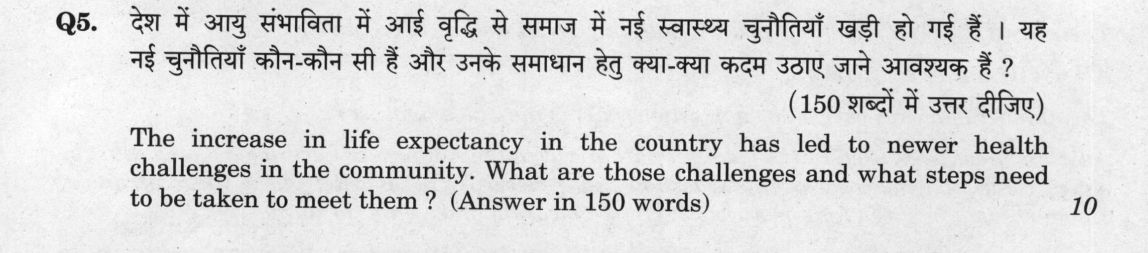
The increase in life expectancy in the country has led to newer health challenges in the community. What are those challenges and what steps need to be taken to meet them? (Answer in 150 words) 10 marks
हिंदी में प्रश्न पढ़ें
देश में आयु संभाविता में आई वृद्धि से समाज में नई स्वास्थ्य चुनौतियाँ खड़ी हो गई हैं। यह नई चुनौतियाँ कौन-कौन सी हैं और उनके समाधान हेतु क्या-क्या कदम उठाए जाने आवश्यक हैं? (150 शब्दों में उत्तर दीजिए)
Model answer
Written by UPSC Answer Check against this question's marking rubric, to the 150-word length. UPSC does not publish answers for Mains — this is one way to score well, not an official key.
India’s rising life expectancy (over 70 years) has shifted the epidemiological burden toward complex, long-term geriatric conditions.
Emerging Health Challenges
- NCDs and Functional Decline: High prevalence of cardiovascular diseases, diabetes, cancer, and neurodegenerative disorders like dementia and Alzheimer’s, compounded by physical disabilities including osteoporosis, falls, and vision/hearing impairments.
- Mental Health and Social Vulnerabilities: Rising rates of depression, loneliness, elder abuse, and suicide, exacerbated by urbanization, the breakdown of traditional intergenerational family support, and gendered vulnerabilities (higher destitution among elderly widows).
- Systemic Gaps: Acute shortages of trained geriatric specialists, inadequate specialized infrastructure, and catastrophic out-of-pocket expenditure.
Steps Needed
- Healthcare Strengthening: Scale up the National Programme for Health Care of the Elderly (NPHCE) across primary centers and widen comprehensive geriatric packages under Ayushman Bharat (PM-JAY).
- Social and Financial Protection: Enhance targeted old-age pension schemes and promote silver economy initiatives for productive, active aging.
- Community-Based Care: Develop local day-care networks, assisted-living models, and certified home-caregiver cadres.
Transitioning from mere longevity to healthy aging requires institutionalizing an integrated continuum of preventive, curative, and palliative care.
What "Enumerate" is asking you to do
Produce the complete set of items asked for, countable and correctly named. The examiner marks against a checklist, so a missing item costs and an elaborated one gains nothing — where discussion is wanted the stem asks for it as a separate sub-part.
Structure that answers it
One line naming the basis on which the set is drawn → items numbered, each in a phrase or a single line → the discussion sub-part taken up separately, after the list is complete
Where marks are lost
Treating it as an essay. Six items named in six lines score better than three items explained at length.
How this answer will be evaluated
Approach
Framework: Situation > Analysis > Measures: legal, institutional, developmental > Assessment. challenges: 3-4 challenges > solutions mapped to them > conclusion Full marks: Identifies 3-4 specific challenges with clear mapping to implementable steps, includes current scheme/data, and maintains logical flow.
Key points expected
- Identify 3-4 specific challenges (e.g., NCDs, geriatric care, mental health)
- Map specific steps to each identified challenge
- Steps must be implementable (legal, institutional, or developmental)
- Maintain logical link between the challenge and the proposed solution
Evaluation rubric
Each sub-part is marked on its own, against the marks and word limit printed on the paper.
- The answer Identify 3-4 specific health challenges arising from increased life expectancy and map implementable steps to meet them. · 150 words
challenges— 3-4 challenges → solutions mapped to them → conclusion
Must cover
- Identify 3-4 specific challenges (e.g., NCDs, geriatric care, mental health)
- Map specific steps to each identified challenge
- Steps must be implementable (legal, institutional, or developmental)
- Maintain logical link between the challenge and the proposed solution
Loses marks
- Generic, aspirational solutions without implementation details
- Newspaper summary style without analytical depth
- Ignoring the specific link to increased life expectancy
Earns more
- Mention of specific schemes (e.g., Ayushman Bharat, AB-PM-JAY)
- Reference to specific institutional mechanisms (e.g., ASHA, PHC)
- Inclusion of data or statistics on NCD burden
- Balanced assessment of current gaps
Extra mark
- One current scheme with a specific number/statistic
- Simple flowchart or diagram illustrating the health system response
Practice this exact question
Write your answer and it is marked point by point against the model answer above — what you covered, what you missed, what you got wrong.
Evaluate my answer →More from General Studies 2022 GS Paper III
- Q2 Is inclusive growth possible under market economy? State the significance of financial in…
- Q3 What are the major challenges of Public Distribution System (PDS) in India? How can it be…
- Q4 Elaborate the scope and significance of the food processing industry in India. (Answer in…
- Q5 The increase in life expectancy in the country has led to newer health challenges in the…
- Q6 Each year a large amount of plant material, cellulose, is deposited on the surface of Pla…
- Q7 Discuss in detail the photochemical smog emphasizing its formation, effects and mitigatio…
- Q8 Explain the mechanism and occurrence of cloudburst in the context of the Indian subcontin…