GS Paper III — Q16
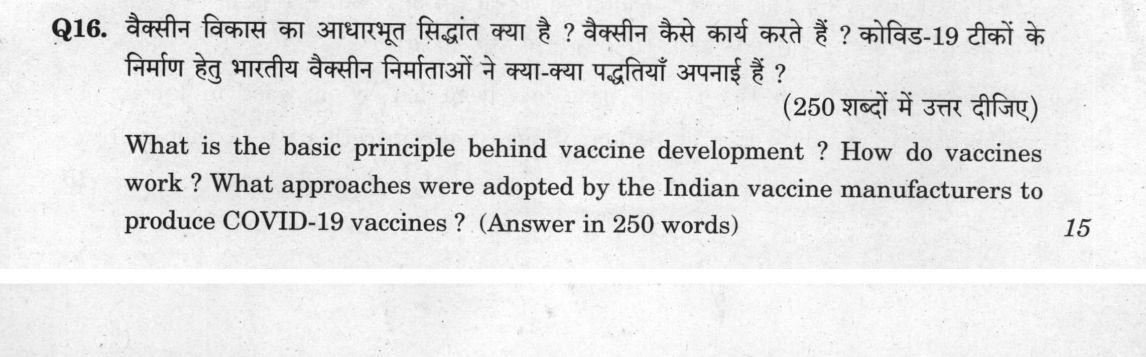
What is the basic principle behind vaccine development? How do vaccines work? What approaches were adopted by the Indian vaccine…
What is the basic principle behind vaccine development? How do vaccines work? What approaches were adopted by the Indian vaccine manufacturers to produce COVID-19 vaccines? (Answer in 250 words) 15 marks
हिंदी में प्रश्न पढ़ें
वैक्सीन विकास का आधारभूत सिद्धांत क्या है? वैक्सीन कैसे कार्य करते हैं? कोविड-19 टीकों के निर्माण हेतु भारतीय वैक्सीन निर्माताओं ने क्या-क्या पद्धतियां अपनाई हैं? (250 शब्दों में उत्तर दीजिए)
Model answer
Written by UPSC Answer Check against this question's marking rubric, to the 250-word length. UPSC does not publish answers for Mains — this is one way to score well, not an official key.
The basic principle of vaccination is the induction of acquired immunity by presenting a harmless antigen—such as an inactivated pathogen, protein subunit, or genetic material—to the immune system to stimulate protective immunological memory without causing clinical disease.
Mechanism of Action
Once introduced, antigen-presenting cells (APCs) capture and display the vaccine antigen to helper T-cells. This triggers a dual immune response: B-cells are activated to differentiate into plasma cells that produce pathogen-specific neutralizing antibodies, while cytotoxic T-cells are primed to destroy infected host cells. Crucially, a subset of these lymphocytes transforms into long-lived memory B and T cells. Upon subsequent exposure to the actual pathogen, these memory cells mount an immediate, high-affinity immune attack, neutralizing the infection before it causes disease.
Approaches Adopted by Indian Manufacturers
Indian manufacturers deployed diverse scientific platforms to develop and mass-produce COVID-19 vaccines:
Inactivated Whole-Virion Platform: Bharat Biotech, in collaboration with the Indian Council of Medical Research (ICMR) and the National Institute of Virology (NIV), developed Covaxin. It utilized chemically inactivated SARS-CoV-2 virions cultured on Vero cells, presenting the complete viral structure to generate broad immunity.
Viral Vector Platform: The Serum Institute of India (SII) partnered with Oxford-AstraZeneca for technology transfer to produce Covishield. It uses a replication-deficient chimpanzee adenovirus (ChAdOx1) vector to deliver the genetic sequence of the spike protein into host cells.
Plasmid DNA Platform: Zydus Cadila developed ZyCoV-D, India's first indigenous plasmid DNA vaccine, utilizing a needle-free applicator to introduce non-replicating DNA plasmids encoding the spike protein.
These diverse approaches highlighted India’s strong indigenous R&D and technology-absorption capacities, advancing the goals of Atmanirbhar Bharat while bolstering global vaccine equity through COVAX and the Vaccine Maitri initiative.
What "Explain" is asking you to do
Make the working of something clear — what sets it off, what follows from what, and what it produces. Explain is the Commission's mechanism word: it dominates the technical papers and the “explain why” stems, where the marks sit in the causal chain and not in the label.
Structure that answers it
State what it is → the initiating condition → the chain of cause, step by step → an instance where it plays out → what the chain produces
Where marks are lost
Describing what something looks like instead of why it works that way. Naming the stages without linking them reads as description too.
How this answer will be evaluated
Approach
Framework: Situation > Analysis > Measures: legal, institutional, developmental > Assessment. explain: definition/context > points in order > small example > short close Full marks: Clear distinction between principle and mechanism; precise identification of Indian platforms (Inactivated/Vector) and manufacturers.
Key points expected
- Define principle: training immune system via antigens
- Explain mechanism: B-cell antibodies and T-cell memory
- Name Indian platforms: Inactivated (Covaxin) and Viral Vector (Covishield)
- Identify manufacturers: Bharat Biotech and Serum Institute
Evaluation rubric
Each sub-part is marked on its own, against the marks and word limit printed on the paper.
- The answer Define vaccine principle, mechanism of action, and specific Indian manufacturing approaches for COVID-19. · 250 words
explain— definition/context → points in order → small example → short close
Must cover
- Define principle: training immune system via antigens
- Explain mechanism: B-cell antibodies and T-cell memory
- Name Indian platforms: Inactivated (Covaxin) and Viral Vector (Covishield)
- Identify manufacturers: Bharat Biotech and Serum Institute
Loses marks
- Confusing vaccine with antiviral treatment
- Listing only vaccine names without explaining the platform
- Vague generalities without naming specific Indian companies
Earns more
- Mention mRNA or Protein subunit as other global approaches
- Reference 'Operation Warp Speed' or 'Operation Mission Indigenization'
Extra mark
- Simple flowchart of immune response (Antigen -> APC -> T/B cells)
- Mention specific adjuvants used (e.g., Alum in Covaxin)
Practice this exact question
Write your answer and it is marked point by point against the model answer above — what you covered, what you missed, what you got wrong.
Evaluate my answer →More from General Studies 2022 GS Paper III
- Q13 What are the main bottlenecks in upstream and downstream process of marketing of agricult…
- Q14 What is Integrated Farming System? How is it helpful to small and marginal farmers in Ind…
- Q15 Launched on 25th December, 2021, James Webb Space Telescope has been much in the news sin…
- Q16 What is the basic principle behind vaccine development? How do vaccines work? What approa…
- Q17 Discuss global warming and mention its effects on the global climate. Explain the control…
- Q18 Explain the causes and effects of coastal erosion in India. What are the available coasta…
- Q19 What are the different elements of cyber security? Keeping in view the challenges in cybe…