GS Paper III — Q10
What are the maritime security challenges in India? Discuss the organisational, technical and procedural initiatives taken to…
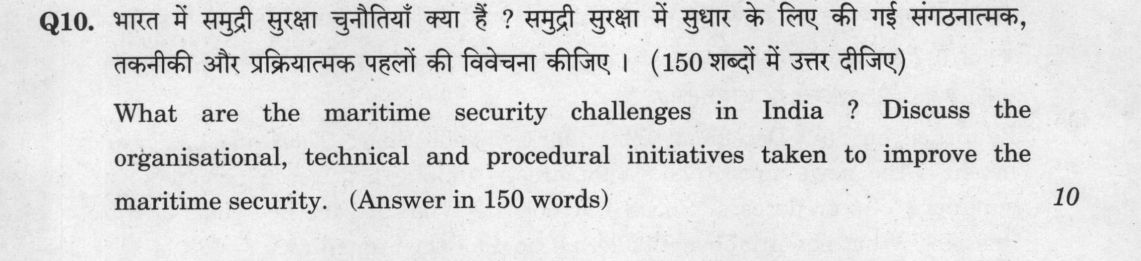
What are the maritime security challenges in India? Discuss the organisational, technical and procedural initiatives taken to improve the maritime security. (Answer in 150 words) 10 marks
हिंदी में प्रश्न पढ़ें
भारत में समुद्री सुरक्षा चुनौतियाँ क्या हैं? समुद्री सुरक्षा में सुधार के लिए की गई संगठनात्मक, तकनीकी और प्रक्रियात्मक पहलों की विवेचना कीजिए। (150 शब्दों में उत्तर दीजिए)
Model answer
Written by UPSC Answer Check against this question's marking rubric, to the 150-word length. UPSC does not publish answers for Mains — this is one way to score well, not an official key.
India’s long coastline and IOR trade make maritime security central. Challenges include piracy in the Gulf of Aden, sea-route terrorism (26/11 Mumbai), illegal fishing, drug/arms smuggling, Chinese presence in the IOR, and climate vulnerabilities. Organisationally, the Navy’s IFC-IOR, NMDA project, Coastal Security Group and SAGAR doctrine integrate surveillance and diplomacy. Technically, a coastal radar chain, AIS, Oceansat/RISAT/Cartosat satellites, and coastal police stations with interceptor boats enhance detection. Procedurally, the Coastal Security Scheme, joint Navy-Coast Guard-State marine police patrols, ISPS Code compliance, and White Shipping agreements regulate ports, vessels and information sharing. Post-26/11 reforms strengthened the earlier Multi-Agency Centre (MAC) and coastal SOPs. Yet gaps remain in data fusion, coastal policing capacity, and Indo-Pacific coordination. A way forward is a single maritime domain awareness grid, faster inter-agency SOPs, and sustained SAGAR partnerships. Continued investment in coastal policing, port security and regional coordination in the IOR will consolidate these gains.
What "Discuss" is asking you to do
Lay the issue out from more than one side — how it arose, what is claimed for it, what is held against it, and where it now stands. UPSC attaches discuss to broad topics with several live dimensions, so coverage of the dimensions earns more than the strength of your opinion.
Structure that answers it
Set the issue up → the case as it is made → the case against → the dimension both sides leave out → where the balance now lies
Where marks are lost
Listing facts with no thread between them, or arguing one side throughout and calling it a discussion.
How this answer will be evaluated
Approach
Framework: Security: classify threat, vulnerability, response. discuss: intro > 3-4 dimensions > example > balanced close Full marks: Clear challenges and distinct, specific examples for all three initiative types.
Key points expected
- 3-4 specific maritime security challenges (e.g., piracy, smuggling)
- Organisational initiatives (e.g., Coast Guard, Joint Command)
- Technical initiatives (e.g., surveillance, radar, drones)
- Procedural initiatives (e.g., port security, protocols, coordination)
Evaluation rubric
Each sub-part is marked on its own, against the marks and word limit printed on the paper.
- The answer Identify maritime challenges and categorize initiatives into organizational, technical, and procedural. · 150 words
discuss— intro → 3-4 dimensions → example → balanced close
Must cover
- 3-4 specific maritime security challenges (e.g., piracy, smuggling)
- Organisational initiatives (e.g., Coast Guard, Joint Command)
- Technical initiatives (e.g., surveillance, radar, drones)
- Procedural initiatives (e.g., port security, protocols, coordination)
Loses marks
- Generic security writing without specific maritime context
- Mixing up organisational and procedural initiatives
- Ignoring the specific categorization requested
Earns more
- Mention of specific agencies (Coast Guard, Navy, Police)
- Reference to specific technology (C-band radar, AIS)
- Mention of specific protocols (ISPS code, port security)
Extra mark
- Reference to specific joint operations (e.g., Operation Sagar)
- Mention of specific international agreements (e.g., IMO)
Practice this exact question
Write your answer and it is marked point by point against the model answer above — what you covered, what you missed, what you got wrong.
Evaluate my answer →More from General Studies 2022 GS Paper III
- Q7 Discuss in detail the photochemical smog emphasizing its formation, effects and mitigatio…
- Q8 Explain the mechanism and occurrence of cloudburst in the context of the Indian subcontin…
- Q9 Discuss the types of organised crimes. Describe the linkages between terrorists and organ…
- Q10 What are the maritime security challenges in India? Discuss the organisational, technical…
- Q11 "Economic growth in the recent past has been led by increase in labour productivity." Exp…
- Q12 Do you think India will meet 50 percent of its energy needs from renewable energy by 2030…
- Q13 What are the main bottlenecks in upstream and downstream process of marketing of agricult…