GS Paper III — Q9
Discuss the types of organised crimes. Describe the linkages between terrorists and organised crime that exist at the national…
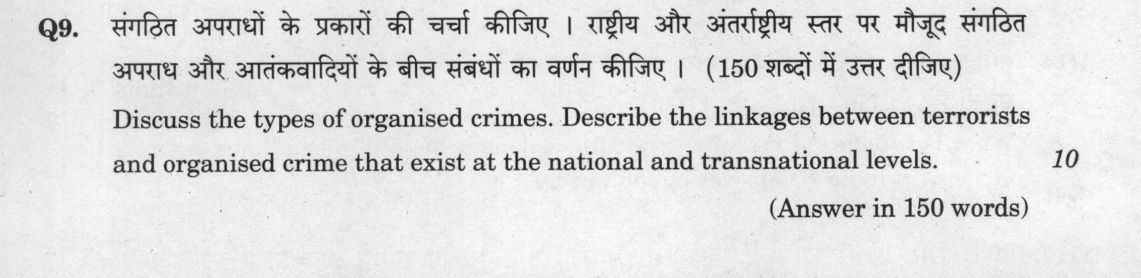
Discuss the types of organised crimes. Describe the linkages between terrorists and organised crime that exist at the national and transnational levels. (Answer in 150 words) 10 marks
हिंदी में प्रश्न पढ़ें
संगठित अपराधों के प्रकारों की चर्चा कीजिए। राष्ट्रीय और अंतर्राष्ट्रीय स्तर पर मौजूद संगठित अपराध और आतंकवादियों के बीच संबंधों का वर्णन कीजिए। (150 शब्दों में उत्तर दीजिए)
Model answer
Written by UPSC Answer Check against this question's marking rubric, to the 150-word length. UPSC does not publish answers for Mains — this is one way to score well, not an official key.
Organised crimes are structured, illegal activities executed for financial or material gain, encompassing drug trafficking, illicit arms smuggling, human trafficking, money laundering, cybercrime, and extortion racketeering.
National-Level Linkages Terrorist groups leverage domestic crime syndicates for financing, logistics, and recruitment. In India, this convergence is visible in the extortion rackets and Fake Indian Currency Note (FICN) networks funding militancy in Jammu & Kashmir, the Northeast insurgent-narcotics nexus, and the Mumbai underworld's logistical role in the 1993 terror attacks.
Transnational-Level Linkages Globally, a symbiotic narco-terror nexus operates across borders. Terror organisations exploit transnational criminal supply chains, as seen in the Taliban’s opium economy and Pakistan-based syndicates facilitating Afghan heroin trafficking. These groups operationalise illicit arms proliferation and finance transmission via hawala channels, shell companies, maritime smuggling corridors, and the dark web.
Way Forward This nexus erodes state authority by weaponising criminal justice gaps. Mitigating it requires universal enforcement of the UN Convention against Transnational Organized Crime (UNTOC), strict compliance with FATF anti-money laundering standards, and coordinated intelligence sharing between the NIA, NCB, and INTERPOL.
What "Discuss" is asking you to do
Lay the issue out from more than one side — how it arose, what is claimed for it, what is held against it, and where it now stands. UPSC attaches discuss to broad topics with several live dimensions, so coverage of the dimensions earns more than the strength of your opinion.
Structure that answers it
Set the issue up → the case as it is made → the case against → the dimension both sides leave out → where the balance now lies
Where marks are lost
Listing facts with no thread between them, or arguing one side throughout and calling it a discussion.
How this answer will be evaluated
Approach
Framework: Security: classify threat, vulnerability, response. discuss: intro > 3-4 dimensions > example > balanced close Full marks: Clear classification of crime types with specific examples of national and transnational crime-terror nexus.
Key points expected
- List 3-4 types of organised crime (e.g., drug trafficking, arms smuggling)
- Define the 'nexus' between organised crime and terrorism
- Describe national level linkages (e.g., funding, logistics, safe havens)
- Describe transnational level linkages (e.g., cross-border networks, global routes)
Evaluation rubric
Each sub-part is marked on its own, against the marks and word limit printed on the paper.
- The answer Classify organised crime types and explain the nexus with terrorism at national and transnational levels. · 150 words
discuss— intro → 3-4 dimensions → example → balanced close
Must cover
- List 3-4 types of organised crime (e.g., drug trafficking, arms smuggling)
- Define the 'nexus' between organised crime and terrorism
- Describe national level linkages (e.g., funding, logistics, safe havens)
- Describe transnational level linkages (e.g., cross-border networks, global routes)
Loses marks
- Treating terrorism and organised crime as identical concepts
- Vague generalities without specific examples of linkages
- Ignoring the transnational dimension of the nexus
Earns more
- Mention specific examples of crime-terror nexus (e.g., Haqqani network, FARC)
- Reference to specific laws (e.g., UAPA, PMLA) or agencies (NIA, NCB)
- Distinction between 'convergence' and 'conflation' of crime and terror
Extra mark
- Reference to specific UNODC or NCRB data on crime-terror nexus
- Mention of specific international conventions (e.g., UNTOC)
Practice this exact question
Write your answer and it is marked point by point against the model answer above — what you covered, what you missed, what you got wrong.
Evaluate my answer →More from General Studies 2022 GS Paper III
- Q6 Each year a large amount of plant material, cellulose, is deposited on the surface of Pla…
- Q7 Discuss in detail the photochemical smog emphasizing its formation, effects and mitigatio…
- Q8 Explain the mechanism and occurrence of cloudburst in the context of the Indian subcontin…
- Q9 Discuss the types of organised crimes. Describe the linkages between terrorists and organ…
- Q10 What are the maritime security challenges in India? Discuss the organisational, technical…
- Q11 "Economic growth in the recent past has been led by increase in labour productivity." Exp…
- Q12 Do you think India will meet 50 percent of its energy needs from renewable energy by 2030…