GS Paper III — Q6
Each year a large amount of plant material, cellulose, is deposited on the surface of Planet Earth. What are the natural…
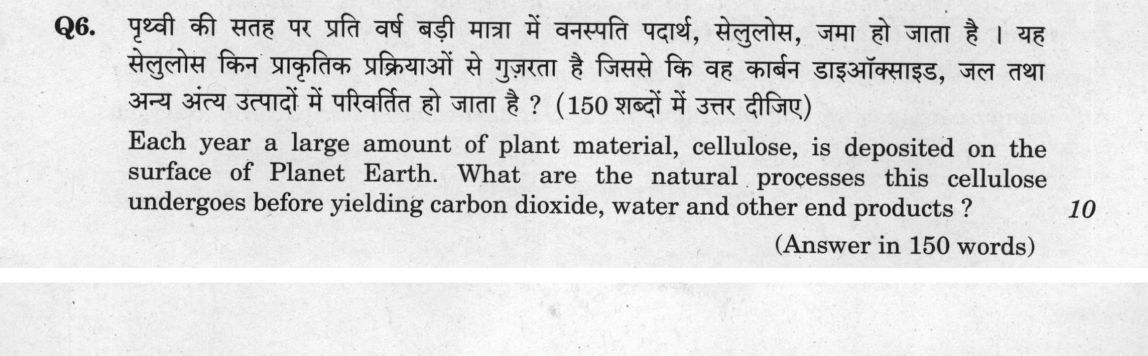
Each year a large amount of plant material, cellulose, is deposited on the surface of Planet Earth. What are the natural processes this cellulose undergoes before yielding carbon dioxide, water and other end products? (Answer in 150 words) 10 marks
हिंदी में प्रश्न पढ़ें
पृथ्वी की सतह पर प्रति वर्ष बड़ी मात्रा में वनस्पति पदार्थ, सेलुलोस, जमा हो जाता है। यह सेलुलोस किन प्राकृतिक प्रक्रियाओं से गुजरता है जिससे कि वह कार्बन डाइऑक्साइड, जल तथा अन्य अंत उत्पादों में परिवर्तित हो जाता है? (150 शब्दों में उत्तर दीजिए)
Model answer
Written by UPSC Answer Check against this question's marking rubric, to the 150-word length. UPSC does not publish answers for Mains — this is one way to score well, not an official key.
Cellulose, Earth’s most abundant biopolymer, is transformed by coupled biological, chemical and thermal processes. In soils, cellulase-producing bacteria such as Cellulomonas and fungi like Trichoderma hydrolyse glycosidic bonds, yielding cellobiose and glucose. Aerobic decomposers oxidise these sugars through glycolysis, the Krebs cycle and the electron transport chain, releasing CO₂, water and heat. In oxygen-poor wetlands, paddy fields and rumen, after hydrolysis, fermentative bacteria convert sugars to organic acids, H₂ and CO₂; methanogenic archaea then use acetate, H₂ and CO₂ to form methane and CO₂. Partially degraded material forms humus and lignin-cellulose complexes, while in peatlands such as the Sundarbans, slow decomposition sequesters carbon; in warm tropical soils, mineralisation is rapid. Abiotic routes include photochemical oxidation, forest-fire combustion and slow thermal degradation, ultimately returning carbon to the atmosphere. Thus, cellulose cycling links plant litter, soil organic matter and atmospheric carbon, regulating climate and soil fertility in terrestrial ecosystems over seasonal cycles.
What "Describe" is asking you to do
Give a full, ordered account of the thing named — its parts, stages or mechanism — in the sequence in which it actually exists or occurs. Most describe questions come from the science optionals, where the marks sit in correct technical detail and, where the stem says so, a labelled diagram.
Structure that answers it
One-line identification of the subject → the parts or stages in their real order, each with its defining detail → labelled diagram where the subject is structural → closing line on function or significance
Where marks are lost
Loose general prose where the examiner is ticking named parts, correct terminology and their sequence; and in the General Studies papers, turning to evaluation before the description is finished.
How this answer will be evaluated
Approach
Framework: Environment: threat, causes, impact, mitigation. trace: start point > the stages in sequence > end point > what changed Full marks: Clear sequence from cellulose to CO2/water with specific biological agents
Key points expected
- Identifies cellulose as the primary substrate
- Describes microbial enzymatic breakdown (cellulase)
- Distinguishes aerobic vs anaerobic pathways
- Links process to carbon cycle
Evaluation rubric
Each sub-part is marked on its own, against the marks and word limit printed on the paper.
- The answer Sequence of natural processes converting cellulose to CO2, water, and other products 10 marks · 150 words
trace— start point → the stages in sequence → end point → what changed
Must cover
- Identifies cellulose as the primary substrate
- Describes microbial enzymatic breakdown (cellulase)
- Distinguishes aerobic vs anaerobic pathways
- Links process to carbon cycle
Loses marks
- Confusing photosynthesis with decomposition
- Vague description without specific processes
- Ignoring the 'natural' constraint (focusing on industrial)
Earns more
- Mention of specific decomposers (bacteria/fungi)
- Reference to intermediate products (glucose, acids)
- Context of soil or aquatic environment
- Mention of methane as an end product
Extra mark
- Simple flowchart of the decomposition pathway
- Specific enzyme names (e.g., endoglucanase)
Practice this exact question
Write your answer and it is marked point by point against the model answer above — what you covered, what you missed, what you got wrong.
Evaluate my answer →More from General Studies 2022 GS Paper III
- Q3 What are the major challenges of Public Distribution System (PDS) in India? How can it be…
- Q4 Elaborate the scope and significance of the food processing industry in India. (Answer in…
- Q5 The increase in life expectancy in the country has led to newer health challenges in the…
- Q6 Each year a large amount of plant material, cellulose, is deposited on the surface of Pla…
- Q7 Discuss in detail the photochemical smog emphasizing its formation, effects and mitigatio…
- Q8 Explain the mechanism and occurrence of cloudburst in the context of the Indian subcontin…
- Q9 Discuss the types of organised crimes. Describe the linkages between terrorists and organ…