GS Paper III — Q19
What are the different elements of cyber security? Keeping in view the challenges in cyber security, examine the extent to which…
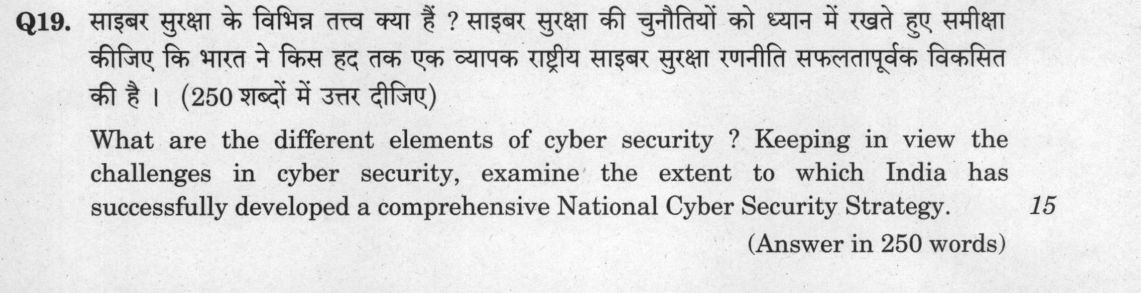
What are the different elements of cyber security? Keeping in view the challenges in cyber security, examine the extent to which India has successfully developed a comprehensive National Cyber Security Strategy. (Answer in 250 words) 15 marks
हिंदी में प्रश्न पढ़ें
साइबर सुरक्षा के विभिन्न तत्व क्या हैं? साइबर सुरक्षा की चुनौतियों को ध्यान में रखते हुए समीक्षा कीजिए कि भारत ने किस हद तक एक व्यापक राष्ट्रीय साइबर सुरक्षा रणनीति सफलतापूर्वक विकसित की है। (250 शब्दों में उत्तर दीजिए)
Model answer
Written by UPSC Answer Check against this question's marking rubric, to the 250-word length. UPSC does not publish answers for Mains — this is one way to score well, not an official key.
Cyber security encompasses the protection of cyberspace, digital assets, and interconnected networks from unauthorized access, disruption, or destruction. Its core elements comprise network security (securing infrastructure against intrusions), application security (vulnerability testing and secure coding), information security (protecting data integrity and confidentiality), operational security (access control and data-handling protocols), disaster recovery and business continuity (resilience and rapid restoration post-incident), and end-user education (mitigating human-factor risks like phishing).
Assessment of India’s Cyber Security Strategy
India transitioned from the foundational National Cyber Security Policy (NCSP) 2013 toward the comprehensive National Cyber Security Strategy (NCSS), accompanied by substantial institutional capacity building:
- Institutional Framework: Operationalisation of CERT-In as the national nodal incident response agency, NCIIPC for protecting Critical Information Infrastructure (under Section 70A of the IT Act), and Cyber Swachhta Kendra for malware analysis and botnet disinfection.
- Capacity Initiatives: Programs like Cyber Surakshit Bharat, the Indian Cyber Crime Coordination Centre (I4C), and the Defence Cyber Agency reflect a proactive shift under Digital India.
Key Challenges and Strategic Deficits
Despite these foundations, India’s strategic posture faces critical gaps:
- Policy and Structural Delays: The formal notification and implementation of the updated NCSS remain pending, causing fragmented inter-agency coordination between MeitY, MHA, and the National Security Council Secretariat (NSCS).
- Critical Infrastructure & Threat Vector: High-profile ransomware attacks on critical systems (such as AIIMS, New Delhi), unresolved supply-chain hardware vulnerabilities, and complexities around data localization reveal systemic operational exposure.
- Ecosystem Gaps: Inadequate domestic R&D for indigenous cybersecurity hardware, low cyber insurance penetration among MSMEs, and an acute deficit of certified cybersecurity professionals weaken overall cyber resilience.
Conclusion
India has successfully built foundational operational nodes, yet its security apparatus remains largely reactive. To achieve a comprehensive defense posture, India must urgently notify the NCSS, unify command under the National Cyber Security Coordinator, and enforce stringent statutory compliance and indigenous technology mandates across critical infrastructure sectors.
What "Examine" is asking you to do
Test the proposition the question puts to you and return a finding on how far it holds. Examine stems carry a claim, or ask whether something has happened, and expect evidence weighed both ways before the extent is stated — often with remedial measures attached.
Structure that answers it
Restate the claim as the question frames it → evidence that supports it → evidence that undercuts it → the conditions under which it holds → verdict on how far it stands
Where marks are lost
Stopping at description. An examination has to reach a finding, and “examine with justification” means the extent must be stated, not implied.
How this answer will be evaluated
Approach
Framework: Situation > Analysis > Measures > Assessment. examine: intro > how/why with reasoning > evidence > conclusion Full marks: Precise elements, specific challenges, named strategies, and a critical assessment of their efficacy.
Key points expected
- Define 3-4 core elements (e.g., data, network, application security)
- Identify 2-3 specific challenges (e.g., ransomware, state-sponsored attacks)
- Name specific Indian strategies (e.g., CERT-In, National Cyber Security Policy)
- Provide a balanced assessment of the strategy's success/limitations
Evaluation rubric
Each sub-part is marked on its own, against the marks and word limit printed on the paper.
- The answer Define elements of cyber security and assess India's strategy against challenges. · 250 words
examine— intro → how/why with reasoning → evidence → conclusion
Must cover
- Define 3-4 core elements (e.g., data, network, application security)
- Identify 2-3 specific challenges (e.g., ransomware, state-sponsored attacks)
- Name specific Indian strategies (e.g., CERT-In, National Cyber Security Policy)
- Provide a balanced assessment of the strategy's success/limitations
Loses marks
- Vague generalities without naming specific Indian policies
- Ignoring the 'challenges' aspect of the prompt
- Listing elements without connecting them to the strategy
Earns more
- Mention specific institutional bodies (e.g., MeitY, NCIIPC)
- Reference specific legal frameworks (e.g., IT Act 2000, DPDP Act)
- Discuss the role of public-private partnerships
- Mention specific initiatives (e.g., Cyber Swachhta Kendra)
Extra mark
- Cite a specific recent cyber incident in India
- Reference a specific international cyber security treaty or forum
Practice this exact question
Write your answer and it is marked point by point against the model answer above — what you covered, what you missed, what you got wrong.
Evaluate my answer →More from General Studies 2022 GS Paper III
- Q16 What is the basic principle behind vaccine development? How do vaccines work? What approa…
- Q17 Discuss global warming and mention its effects on the global climate. Explain the control…
- Q18 Explain the causes and effects of coastal erosion in India. What are the available coasta…
- Q19 What are the different elements of cyber security? Keeping in view the challenges in cybe…
- Q20 Naxalism is a social, economic and developmental issue manifesting as a violent internal…