GS Paper III — Q7
Discuss in detail the photochemical smog emphasizing its formation, effects and mitigation. Explain the 1999 Gothenburg Protocol…
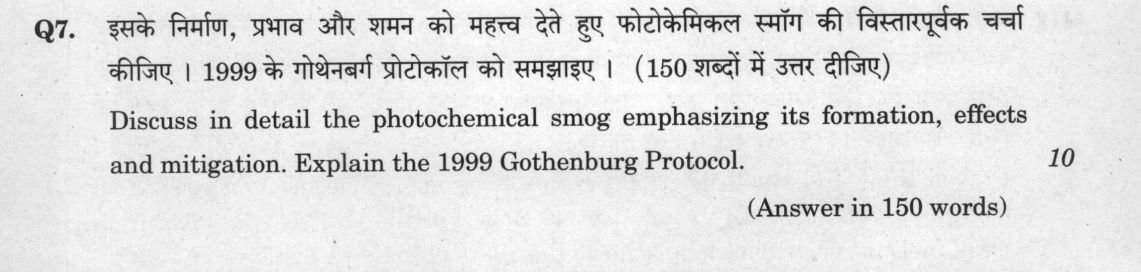
Discuss in detail the photochemical smog emphasizing its formation, effects and mitigation. Explain the 1999 Gothenburg Protocol. (Answer in 150 words) 10 marks
हिंदी में प्रश्न पढ़ें
इसके निर्माण, प्रभाव और शमन को महत्व देते हुए फोटोकैमिकल स्मॉग की विस्तारपूर्वक चर्चा कीजिए। 1999 के गोथेनबर्ग प्रोटोकॉल को समझाइए। (150 शब्दों में उत्तर दीजिए)
Model answer
Written by UPSC Answer Check against this question's marking rubric, to the 150-word length. UPSC does not publish answers for Mains — this is one way to score well, not an official key.
Photochemical smog is a hazardous haze formed when primary pollutants—Nitrogen Oxides (NOₓ) and Volatile Organic Compounds (VOCs)—react in the presence of solar radiation to generate secondary pollutants, primarily ground-level ozone (O₃), peroxyacetyl nitrate (PAN), and aldehydes. Winter temperature inversion further traps these pollutants near the surface.
Effects: It triggers respiratory distress, eye irritation, and reduced lung function. It also causes leaf necrosis, retards crop yields, and impairs atmospheric visibility.
Mitigation: Measures include adopting BS-VI vehicular emission norms, installing catalytic converters, vehicle rationing like odd-even schemes, industrial emission limits, and urban greening.
Gothenburg Protocol (1999): Formulated under the UNECE Convention on Long-Range Transboundary Air Pollution, this treaty aims to abate acidification, eutrophication, and ground-level ozone. It employs a multi-pollutant approach, setting national emission ceilings based on "critical loads" for four pollutants: SO₂, NOₓ, VOCs, and NH₃ (later including PM₂.5).
Although India is not a party to this regional protocol, adopting its multi-pollutant, critical-load framework within the National Clean Air Programme (NCAP) can strengthen domestic air quality governance.
What "Discuss" is asking you to do
Lay the issue out from more than one side — how it arose, what is claimed for it, what is held against it, and where it now stands. UPSC attaches discuss to broad topics with several live dimensions, so coverage of the dimensions earns more than the strength of your opinion.
Structure that answers it
Set the issue up → the case as it is made → the case against → the dimension both sides leave out → where the balance now lies
Where marks are lost
Listing facts with no thread between them, or arguing one side throughout and calling it a discussion.
How this answer will be evaluated
Approach
Framework: Environment: threat, causes, impact, mitigation. discuss: intro > 3-4 dimensions > example > balanced close Full marks: Covers all four components (formation, effects, mitigation, protocol) with specific chemical/policy details.
Key points expected
- Formation via NOx/VOCs and sunlight
- Specific health or environmental impacts
- Mitigation measures (e.g., catalytic converters)
- Explanation of 1999 Gothenburg Protocol
Evaluation rubric
Each sub-part is marked on its own, against the marks and word limit printed on the paper.
- The answer Explain photochemical smog formation, effects, mitigation, and the 1999 Gothenburg Protocol. · 150 words
discuss— intro → 3-4 dimensions → example → balanced close
Must cover
- Formation via NOx/VOCs and sunlight
- Specific health or environmental impacts
- Mitigation measures (e.g., catalytic converters)
- Explanation of 1999 Gothenburg Protocol
Loses marks
- Confusing photochemical with industrial smog
- Vague mitigation without specific measures
- Ignoring the Gothenburg Protocol part
Earns more
- Mention of Ozone (O3) as key component
- Reference to UNECE Convention on LRTAP
- Specific mitigation policy (e.g., emission standards)
Extra mark
- Mention of PAN (Peroxyacetyl nitrate)
- Specific reduction targets of the Protocol
Practice this exact question
Write your answer and it is marked point by point against the model answer above — what you covered, what you missed, what you got wrong.
Evaluate my answer →More from General Studies 2022 GS Paper III
- Q4 Elaborate the scope and significance of the food processing industry in India. (Answer in…
- Q5 The increase in life expectancy in the country has led to newer health challenges in the…
- Q6 Each year a large amount of plant material, cellulose, is deposited on the surface of Pla…
- Q7 Discuss in detail the photochemical smog emphasizing its formation, effects and mitigatio…
- Q8 Explain the mechanism and occurrence of cloudburst in the context of the Indian subcontin…
- Q9 Discuss the types of organised crimes. Describe the linkages between terrorists and organ…
- Q10 What are the maritime security challenges in India? Discuss the organisational, technical…