GS Paper III — Q11
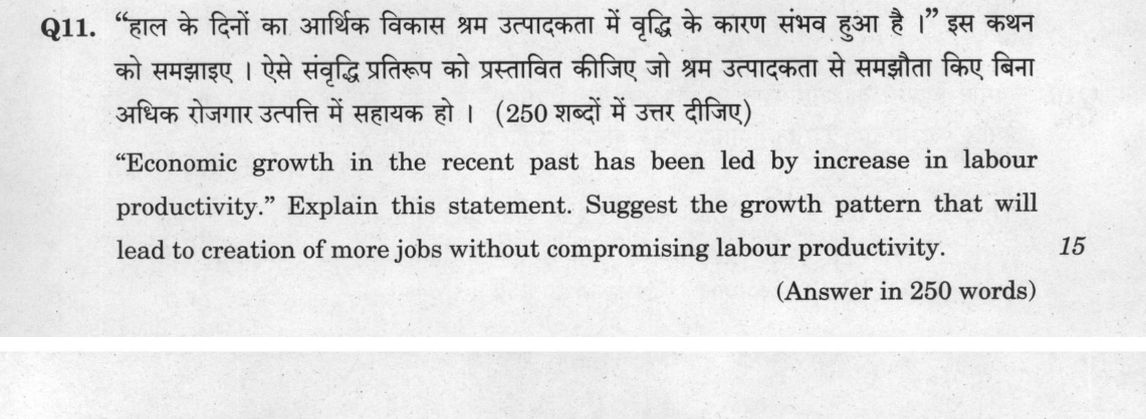
"Economic growth in the recent past has been led by increase in labour productivity." Explain this statement. Suggest the growth…
"Economic growth in the recent past has been led by increase in labour productivity." Explain this statement. Suggest the growth pattern that will lead to creation of more jobs without compromising labour productivity. (Answer in 250 words) 15 marks
हिंदी में प्रश्न पढ़ें
"हाल के दिनों का आर्थिक विकास श्रम उत्पादकता में वृद्धि के कारण संभव हुआ है।" इस कथन को समझाइए। ऐसे संवृद्धि प्रतिरूप को प्रस्तावित कीजिए जो श्रम उत्पादकता से समझौता किए बिना अधिक रोजगार उत्पत्ति में सहायक हो। (250 शब्दों में उत्तर दीजिए)
Model answer
Written by UPSC Answer Check against this question's marking rubric, to the 250-word length. UPSC does not publish answers for Mains — this is one way to score well, not an official key.
Labour productivity, defined as real output generated per worker, reflects the transition from extensive growth (adding more labour) to intensive growth (increasing efficiency per worker). In recent decades, India’s GDP expansion has been driven predominantly by rising labour productivity rather than employment generation, leading to the phenomenon of jobless or low-employment elasticity growth.
Mechanisms Driving Productivity-Led Growth
The decoupling of output growth from employment stems from structural and technological shifts:
Capital-Intensive Sectoral Skew: Growth has been concentrated in services such as IT, telecommunications, and financial services, alongside automated manufacturing, which generate high value-added output with low direct labour absorption.
Technological Change and Automation: Adoption of skill-biased technologies, digital processes, and automation has increased output per worker while reducing overall labour intensity.
Formalization: Post-reform restructuring and compliance pressures have incentivized firms to invest in capital deepening rather than expanding their workforce.
Suggested Growth Pattern for Jobs with Productivity
Achieving job creation without diluting productivity requires shifting from capital-concentrated growth to high-productivity, labour-absorbing value chains:
Labour-Intensive Manufacturing: Prioritize sectors like textiles, apparel, leather, and food processing through targeted Production Linked Incentive (PLI) schemes, ensuring modern technology adoption alongside large-scale employment.
MSME Modernization: Facilitate formal credit and technological upgrades for Micro, Small, and Medium Enterprises, allowing smaller firms to achieve economies of scale and integrate into global value chains.
Rural Non-Farm Employment: Expand agro-processing, rural infrastructure, and warehousing to productively absorb disguised underemployment from agriculture without depressing rural wages.
Human Capital and Services: Align skill development under the Skill India Mission with emerging service sub-sectors, such as logistics, healthcare, and tourism, which naturally combine high labour demand with rising productivity.
India must avoid treating employment and productivity as a zero-sum trade-off; moving labour from low-productivity agriculture to higher-productivity manufacturing and modern services provides the only sustainable pathway to inclusive economic growth.
What "Explain" is asking you to do
Make the working of something clear — what sets it off, what follows from what, and what it produces. Explain is the Commission's mechanism word: it dominates the technical papers and the “explain why” stems, where the marks sit in the causal chain and not in the label.
Structure that answers it
State what it is → the initiating condition → the chain of cause, step by step → an instance where it plays out → what the chain produces
Where marks are lost
Describing what something looks like instead of why it works that way. Naming the stages without linking them reads as description too.
How this answer will be evaluated
Approach
Framework: Situation > Analysis > Measures > Assessment. explain: definition/context > points in order > small example > short close Full marks: Clear explanation of productivity-led growth with a specific, implementable job-creating pattern.
Key points expected
- Define labour productivity and its role in GDP growth
- Explain the mechanism of productivity-led growth (capital deepening/tech)
- Suggest a specific growth pattern (e.g., labour-intensive sectors)
- Explain how the suggested pattern creates jobs without lowering productivity
Evaluation rubric
Each sub-part is marked on its own, against the marks and word limit printed on the paper.
- The answer Explain the link between productivity and growth, then suggest a job-creating growth pattern. · 250 words
explain— definition/context → points in order → small example → short close
Must cover
- Define labour productivity and its role in GDP growth
- Explain the mechanism of productivity-led growth (capital deepening/tech)
- Suggest a specific growth pattern (e.g., labour-intensive sectors)
- Explain how the suggested pattern creates jobs without lowering productivity
Loses marks
- Confusing economic growth with economic development
- Suggesting growth patterns that explicitly lower productivity
- Vague suggestions without implementation details
Earns more
- Mention 'inclusive growth' or 'employment elasticity' concepts
- Reference specific sectors (MSME, services, agriculture)
- Discuss the trade-off between capital and labour intensity
- Mention skill development as a productivity enabler
Extra mark
- Cite a specific scheme (e.g., PMEGP, MUDRA) with a figure
- Draw a simple flowchart of the growth pattern
Practice this exact question
Write your answer and it is marked point by point against the model answer above — what you covered, what you missed, what you got wrong.
Evaluate my answer →More from General Studies 2022 GS Paper III
- Q8 Explain the mechanism and occurrence of cloudburst in the context of the Indian subcontin…
- Q9 Discuss the types of organised crimes. Describe the linkages between terrorists and organ…
- Q10 What are the maritime security challenges in India? Discuss the organisational, technical…
- Q11 "Economic growth in the recent past has been led by increase in labour productivity." Exp…
- Q12 Do you think India will meet 50 percent of its energy needs from renewable energy by 2030…
- Q13 What are the main bottlenecks in upstream and downstream process of marketing of agricult…
- Q14 What is Integrated Farming System? How is it helpful to small and marginal farmers in Ind…