GS Paper III — Q12
Do you think India will meet 50 percent of its energy needs from renewable energy by 2030? Justify your answer. How will the…
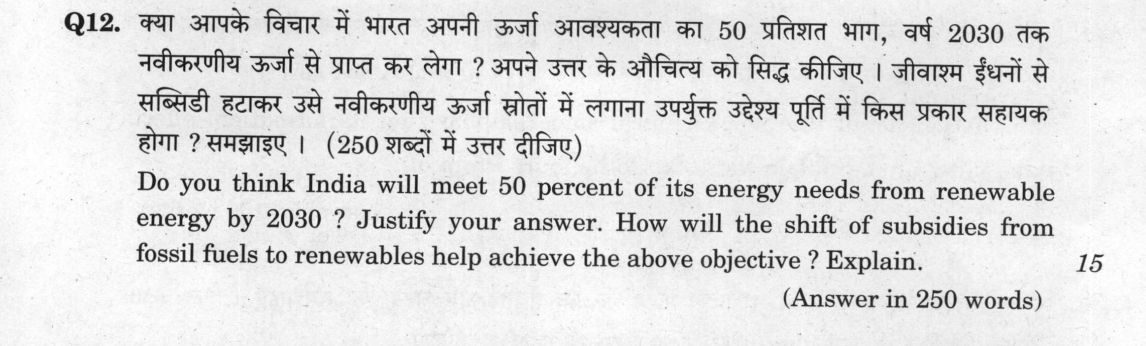
Do you think India will meet 50 percent of its energy needs from renewable energy by 2030? Justify your answer. How will the shift of subsidies from fossil fuels to renewables help achieve the above objective? Explain. (Answer in 250 words) 15 marks
हिंदी में प्रश्न पढ़ें
क्या आपके विचार में भारत अपनी ऊर्जा आवश्यकता का 50 प्रतिशत भाग, वर्ष 2030 तक नवीकरणीय ऊर्जा से प्राप्त कर लेगा? अपने उत्तर के औचित्य को सिद्ध कीजिए। जीवाश्म ईंधनों से सब्सिडी हटाकर उसे नवीकरणीय ऊर्जा स्रोतों में लगाना उपर्युक्त उद्देश्य पूर्ति में किस प्रकार सहायक होगा? समझाइए। (250 शब्दों में उत्तर दीजिए)
Model answer
Written by UPSC Answer Check against this question's marking rubric, to the 250-word length. UPSC does not publish answers for Mains — this is one way to score well, not an official key.
India is unlikely to meet 50 per cent of its total energy needs from renewables by 2030, though it can meet its official NDC target of 50 per cent non-fossil installed capacity. The distinction matters: total energy needs include transport, industry, cooking and heating, where fossil fuels still dominate, while installed capacity is only a supply-side indicator. India’s renewable capacity is about 180 GW in 2024; the related 50 per cent non-fossil capacity target implies moving towards about 500 GW by 2030, requiring roughly 53 GW of additional capacity each year. This is ambitious but feasible given 175 GW achieved by 2022, leadership in the International Solar Alliance, and state renewable purchase obligations.
The main objection is that renewables are now cost-competitive. That is true for electricity, but the gap remains in grid integration, storage deficit, land acquisition delays and financing gaps. Weak DISCOM finances and inadequate transmission are key constraints. Cross-border grid connectivity and battery storage are essential.
Shifting subsidies from fossil fuels to renewables helps by creating fiscal space. Reducing LPG, kerosene and diesel subsidies can fund green bonds, PLI schemes and the National Green Hydrogen Mission. This lowers the cost of storage, grid upgrades and clean transport, making a larger renewable share of final energy possible.
Thus, a 50 per cent renewable share of total energy needs is not yet realistic by 2030, but the 50 per cent non-fossil capacity target is achievable with faster DISCOM reforms, storage, transmission and subsidy reallocation.
What "Justify" is asking you to do
Defend a position with reasons that carry evidence, and show why the contrary view does not hold. Where the stem runs as a question and asks you to justify your answer, the position is yours to choose and the marks lie wholly in the defence.
Structure that answers it
Position stated plainly → reason 1 with evidence → reason 2 with evidence → strongest objection, met → position restated as qualified
Where marks are lost
Reasons stated and none of them evidenced. The other standard loss is fence-sitting — an answer that finds merit on both sides and commits to neither has justified nothing.
How this answer will be evaluated
Approach
Framework: GS3 Environment/Energy Policy. justify: claim > 3-4 reasons > evidence > conclusion Full marks: Clear stance with 3-4 strong reasons, detailed subsidy shift explanation, specific data/schemes.
Key points expected
- Clear stance on 50% target feasibility
- 3-4 reasons justifying the stance
- Explanation of fossil fuel subsidy removal
- Explanation of renewable energy subsidy benefits
Evaluation rubric
Each sub-part is marked on its own, against the marks and word limit printed on the paper.
- The answer Assess feasibility of 50% renewable energy target by 2030 and explain subsidy shift mechanism. · 250 words
justify— claim → 3-4 reasons → evidence → conclusion
Must cover
- Clear stance on 50% target feasibility
- 3-4 reasons justifying the stance
- Explanation of fossil fuel subsidy removal
- Explanation of renewable energy subsidy benefits
Loses marks
- Vague generalities without specific reasons
- Ignoring the subsidy shift component
- Aspirational writing without implementable measures
Earns more
- Mention of specific renewable sources (solar, wind)
- Reference to grid integration challenges
- Mention of economic impact of subsidy shift
- Reference to international commitments (Paris Agreement)
Extra mark
- Specific data on current renewable energy capacity
- Mention of specific government schemes (e.g., PM Surya Ghar)
Practice this exact question
Write your answer and it is marked point by point against the model answer above — what you covered, what you missed, what you got wrong.
Evaluate my answer →More from General Studies 2022 GS Paper III
- Q9 Discuss the types of organised crimes. Describe the linkages between terrorists and organ…
- Q10 What are the maritime security challenges in India? Discuss the organisational, technical…
- Q11 "Economic growth in the recent past has been led by increase in labour productivity." Exp…
- Q12 Do you think India will meet 50 percent of its energy needs from renewable energy by 2030…
- Q13 What are the main bottlenecks in upstream and downstream process of marketing of agricult…
- Q14 What is Integrated Farming System? How is it helpful to small and marginal farmers in Ind…
- Q15 Launched on 25th December, 2021, James Webb Space Telescope has been much in the news sin…