GS Paper III — Q15
Launched on 25th December, 2021, James Webb Space Telescope has been much in the news since then. What are its unique features…
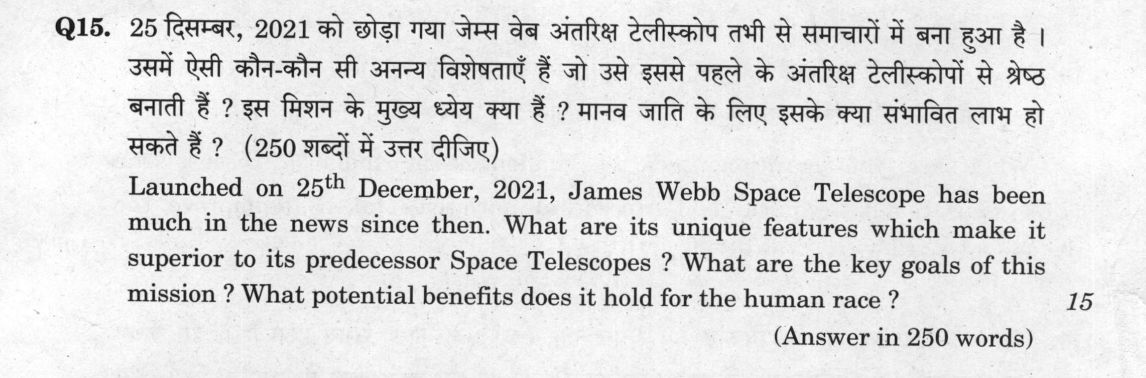
Launched on 25th December, 2021, James Webb Space Telescope has been much in the news since then. What are its unique features which make it superior to its predecessor Space Telescopes? What are the key goals of this mission? What potential benefits does it hold for the human race? (Answer in 250 words) 15 marks
हिंदी में प्रश्न पढ़ें
25 दिसंबर, 2021 को छोड़ा गया जेम्स वेब अंतरिक्ष टेलीस्कोप तभी से समाचारों में बना हुआ है। उसमें ऐसी कौन-कौन सी अनन्य विशेषताएं हैं जो उसे इससे पहले के अंतरिक्ष टेलीस्कोपों से श्रेष्ठ बनाती हैं? इस मिशन के मुख्य ध्येय क्या हैं? मानव जाति के लिए इसके क्या संभावित लाभ हो सकते हैं? (250 शब्दों में उत्तर दीजिए)
Model answer
Written by UPSC Answer Check against this question's marking rubric, to the 250-word length. UPSC does not publish answers for Mains — this is one way to score well, not an official key.
The James Webb Space Telescope (JWST), operating at the Sun-Earth Lagrange Point 2 (L2), represents a generational leap in observational astronomy, overcoming the optical and thermal constraints of predecessors like Hubble and Spitzer.
Unique Features and Superiority JWST features a 6.5-metre primary mirror composed of 18 hexagonal beryllium segments coated with gold, offering over six times the light-collecting area of Hubble’s 2.4-metre mirror. Situated in a halo orbit at L2 (1.5 million km from Earth) rather than Low Earth Orbit, it avoids Earth's thermal interference. A five-layer tennis-court-sized sunshield ensures passive cryogenic cooling below -233°C. This allows instruments like the Near-Infrared Camera (NIRCam) and Mid-Infrared Instrument (MIRI) to operate across 0.6 to 28 microns. This infrared sensitivity penetrates dense cosmic dust and detects ancient, redshifted light invisible to optical telescopes.
Key Mission Goals JWST is structured around four primary objectives: First Light and Reionization: Capturing the earliest stars and galaxies formed after the Big Bang, as validated by the JADES survey. Assembly of Galaxies: Tracing structural evolution over cosmic time. Birth of Stars and Protoplanetary Systems: Peering through stellar nurseries to understand planetary formation. Exoplanetary Atmospheres: Analyzing chemical compositions and biosignatures, demonstrated by detecting carbon dioxide on WASP-39b.
Benefits to Humanity and Relevance for India JWST expands fundamental knowledge of cosmic origins and planetary habitability. The mission drives tangible technological spin-offs in wavefront sensing, laser interferometry, and medical ophthalmology, while inspiring global STEM education. For India, JWST’s deep-space engineering provides operational lessons for ISRO’s Aditya-L1 and future AstroSat-2 missions, bolstering collaborative avenues under frameworks like NASA-ISRO (NISAR).
What "Explain" is asking you to do
Make the working of something clear — what sets it off, what follows from what, and what it produces. Explain is the Commission's mechanism word: it dominates the technical papers and the “explain why” stems, where the marks sit in the causal chain and not in the label.
Structure that answers it
State what it is → the initiating condition → the chain of cause, step by step → an instance where it plays out → what the chain produces
Where marks are lost
Describing what something looks like instead of why it works that way. Naming the stages without linking them reads as description too.
How this answer will be evaluated
Approach
Framework: Technology: why it matters, use, benefit, risk, policy. compare: paired headings or table > key differences > significance > conclusion Full marks: Precise technical comparison (mirror size, IR vs Optical) and clear mission goals.
Key points expected
- 6.5m segmented mirror vs Hubble's 2.4m
- Infrared capability vs Hubble's optical/UV
- L2 orbit vs Hubble's LEO
- Key goals: exoplanets, first galaxies, star formation
Evaluation rubric
Each sub-part is marked on its own, against the marks and word limit printed on the paper.
- The answer Contrast JWST features with predecessors, list mission goals, and assess benefits for humanity. · 250 words
compare— paired headings or table → key differences → significance → conclusion
Must cover
- 6.5m segmented mirror vs Hubble's 2.4m
- Infrared capability vs Hubble's optical/UV
- L2 orbit vs Hubble's LEO
- Key goals: exoplanets, first galaxies, star formation
Loses marks
- Vague 'better technology' without specifics
- Confusing JWST with Hubble's orbit
- Ignoring the 'benefits to humanity' aspect
Earns more
- Mention of 5-layer sunshield
- Specific exoplanet atmosphere analysis
- Dark matter/energy investigation
- Comparison of light-gathering power
Extra mark
- Specific launch date (25 Dec 2021)
- Mention of specific instruments (NIRCam, MIRI)
Practice this exact question
Write your answer and it is marked point by point against the model answer above — what you covered, what you missed, what you got wrong.
Evaluate my answer →More from General Studies 2022 GS Paper III
- Q12 Do you think India will meet 50 percent of its energy needs from renewable energy by 2030…
- Q13 What are the main bottlenecks in upstream and downstream process of marketing of agricult…
- Q14 What is Integrated Farming System? How is it helpful to small and marginal farmers in Ind…
- Q15 Launched on 25th December, 2021, James Webb Space Telescope has been much in the news sin…
- Q16 What is the basic principle behind vaccine development? How do vaccines work? What approa…
- Q17 Discuss global warming and mention its effects on the global climate. Explain the control…
- Q18 Explain the causes and effects of coastal erosion in India. What are the available coasta…