GS Paper III — Q1
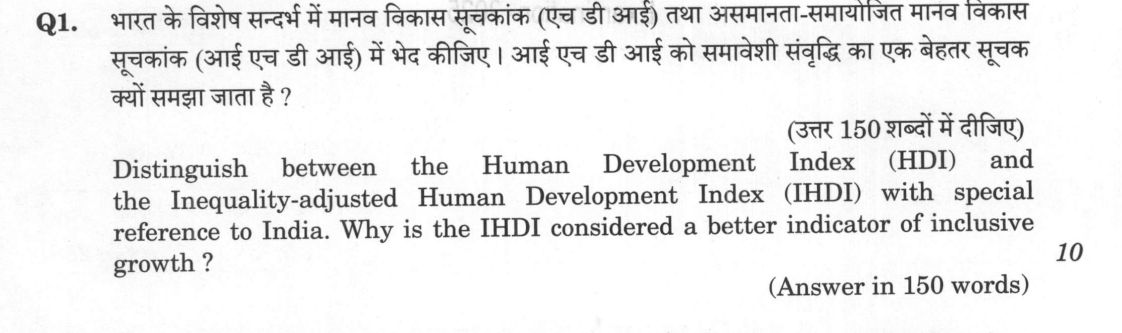
Distinguish between the Human Development Index (HDI) and the Inequality-adjusted Human Development Index (IHDI) with special…
Distinguish between the Human Development Index (HDI) and the Inequality-adjusted Human Development Index (IHDI) with special reference to India. Why is the IHDI considered a better indicator of inclusive growth ? (Answer in 150 words) 10 marks
हिंदी में प्रश्न पढ़ें
भारत के विशेष संदर्भ में मानव विकास सूचकांक (एच डी आई) तथा असमानता-समायोजित मानव विकास सूचकांक (आई एच डी आई) में भेद कीजिए। आई एच डी आई को समावेशी संवृद्धि का एक बेहतर सूचक क्यों समझा जाता है ? (उत्तर 150 शब्दों में दीजिए)
Model answer
Written by UPSC Answer Check against this question's marking rubric, to the 150-word length. UPSC does not publish answers for Mains — this is one way to score well, not an official key.
HDI estimates a country’s average achievement in health, education and income using life expectancy, mean/expected years of schooling and GNI per capita. IHDI starts from the same dimensions but adjusts them for inequality in their distribution, using the Atkinson inequality index, so it penalises unequal distribution more severely than HDI’s mean-based approach. For India, the 2021 national HDI was 0.633, while the IHDI was 0.475, implying a substantial loss of about 25 per cent due to inequality in health, education and income. This overall gap is clearly visible in regional disparities—Kerala’s higher health and education outcomes versus Bihar’s lower ones—gender gaps in maternal health and schooling, and income concentration in the top decile. Because IHDI captures whether gains reach the bottom and middle, not just aggregate progress, it reflects development for all and aligns with SDG 10. Thus, IHDI is therefore a better overall indicator of inclusive growth for India.
What "Distinguish" is asking you to do
Name the property that separates the items and say which side holds it. Distinguish is marked exactly as differentiate is, with no difference in expectation, but its stems more often line up three terms rather than two — gender equality, gender equity and empowerment — and every pair in the set has to be separated.
Structure that answers it
The category they all sit in → the property dividing the first pair → the second pair → the third → why the boundary matters in practice
Where marks are lost
Separating the two obviously different items and leaving the middle term unplaced. A description of each side from which the line must be inferred is marked as description, not as a distinction.
How this answer will be evaluated
Approach
Framework: compare. compare: paired headings or table > key differences > significance > conclusion Full marks: Clear distinction with India-specific data, precise explanation of inequality adjustment, strong inclusive growth argument
Key points expected
- Define HDI components (health, education, income)
- Define IHDI as HDI adjusted for inequality
- Reference India's specific HDI/IHDI context
- Explain why IHDI captures inclusive growth better
Evaluation rubric
Each sub-part is marked on its own, against the marks and word limit printed on the paper.
- The answer Distinguish HDI from IHDI in India and justify IHDI as a better indicator of inclusive growth. 10 marks · 150 words
compare— paired headings or table → key differences → significance → conclusion
Must cover
- Define HDI components (health, education, income)
- Define IHDI as HDI adjusted for inequality
- Reference India's specific HDI/IHDI context
- Explain why IHDI captures inclusive growth better
Loses marks
- Confusing HDI with GDI or other indices
- Ignoring the 'India' reference requirement
- Treating IHDI as a separate index rather than adjusted HDI
Earns more
- Mention specific inequality dimensions (gender, region)
- Note India's HDI rank or value
- Mention UNDP as source
- Contrast average vs distribution of development
Extra mark
- Cite specific India HDI/IHDI value or rank
- Mention specific inequality dimension (e.g., gender, caste)
Practice this exact question
Write your answer and it is marked point by point against the model answer above — what you covered, what you missed, what you got wrong.
Evaluate my answer →More from General Studies 2025 GS Paper III
- Q1 Distinguish between the Human Development Index (HDI) and the Inequality-adjusted Human D…
- Q2 What are the challenges before the Indian economy when the world is moving away from free…
- Q3 Explain the factors influencing the decision of the farmers on the selection of high valu…
- Q4 Elaborate the scope and significance of supply chain management of agricultural commoditi…