GS Paper III — Q13
Examine the factors responsible for depleting groundwater in India. What are the steps taken by the government to mitigate such…
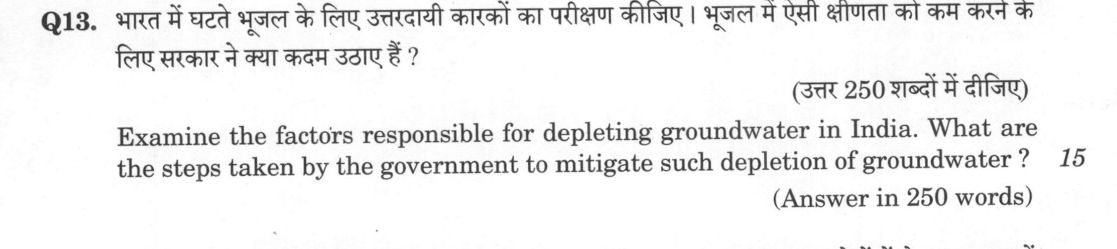
Examine the factors responsible for depleting groundwater in India. What are the steps taken by the government to mitigate such depletion of groundwater ? (Answer in 250 words) 15 marks
हिंदी में प्रश्न पढ़ें
भारत में घटते भूजल के लिए उत्तरदायी कारकों का परीक्षण कीजिए। भूजल में ऐसी क्षीणता को कम करने के लिए सरकार ने क्या कदम उठाए हैं ? (उत्तर 250 शब्दों में दीजिए)
Model answer
Written by UPSC Answer Check against this question's marking rubric, to the 250-word length. UPSC does not publish answers for Mains — this is one way to score well, not an official key.
India is the world’s largest extractor of groundwater, drawing over a quarter of the global total, which has led to severe aquifer stress across multiple regions.
Factors Responsible for Depletion
Natural Factors: Spatial-temporal variability and erratic monsoon patterns severely curtail natural recharge. Furthermore, hard rock aquifers across peninsular India have low storage and percolation capacities, which, coupled with limited surface water storage, intensifies reliance on deep aquifers.
Anthropogenic Drivers: Agriculture consumes nearly 90% of extracted groundwater. The dominance of flood irrigation and water-intensive cropping patterns, such as the paddy-wheat cycle in northwestern India and sugarcane in western states, drives over-extraction. Concurrently, rapid urbanization causes surface concretization that blocks recharge, while burgeoning industrial demand further depletes reservoirs.
Mitigation Steps Taken by the Government
Policy Interventions: The National Aquifer Mapping and Management Programme (NAQUIM) maps aquifer geometries to facilitate targeted recharge. The Jal Shakti Abhiyan promotes water harvesting, while the Atal Bhujal Yojana incentivizes community-led, participatory groundwater management.
Legal and Regulatory Measures: The Central Ground Water Authority (CGWA) enforces extraction guidelines and bans new tubewells in over-exploited and notified areas. The Model Groundwater Bill (2016) provides a framework for state-level regulation and aquifer protection.
Technological Interventions: The Pradhan Mantri Krishi Sinchayee Yojana (PMKSY) promotes micro-irrigation (drip and sprinkler), alongside state mandates for rooftop rainwater harvesting and the construction of artificial recharge structures.
Critical Gaps and Finding
An examination indicates that the crisis persists due to structural bottlenecks: unmetered electricity subsidies that incentivize over-pumping, sluggish progress on crop diversification, unresolved inter-state aquifer disputes, and weak CGWA enforcement. Moving forward, sustainable aquifer management requires coupling technical recharge with strict power-tariff rationalization and enforceable demand-side water budgets.
What "Examine" is asking you to do
Test the proposition the question puts to you and return a finding on how far it holds. Examine stems carry a claim, or ask whether something has happened, and expect evidence weighed both ways before the extent is stated — often with remedial measures attached.
Structure that answers it
Restate the claim as the question frames it → evidence that supports it → evidence that undercuts it → the conditions under which it holds → verdict on how far it stands
Where marks are lost
Stopping at description. An examination has to reach a finding, and “examine with justification” means the extent must be stated, not implied.
How this answer will be evaluated
Approach
Framework: GS3 Environment: Threat, Causes, Impact, Mitigation. examine: intro > how/why with reasoning > evidence > conclusion Full marks: Balanced analysis of agri/urban causes with specific legal (2019 Act) and developmental (ABJY) measures.
Key points expected
- Agricultural over-extraction (tubewells, water-intensive crops)
- Industrial and urban demand factors
- Legal/Institutional measures (Jal Shakti, CGWA, 2019 Act)
- Developmental measures (Jal Jeevan Mission, rainwater harvesting)
Evaluation rubric
Each sub-part is marked on its own, against the marks and word limit printed on the paper.
- The answer Identify causes of groundwater depletion and government mitigation measures. · 250 words
examine— intro → how/why with reasoning → evidence → conclusion
Must cover
- Agricultural over-extraction (tubewells, water-intensive crops)
- Industrial and urban demand factors
- Legal/Institutional measures (Jal Shakti, CGWA, 2019 Act)
- Developmental measures (Jal Jeevan Mission, rainwater harvesting)
Loses marks
- Generic 'awareness' measures without specific schemes
- Ignoring the legal framework (2019 Act)
- Focusing only on climate change, ignoring human factors
Earns more
- Mention of 'Critical' or 'Over-exploited' zones
- Reference to 'Atal Bhujal Yojana' (ABJY)
- Mention of 'National Aquifer Mapping Programme'
- Reference to 'Groundwater (Management and Regulation) Act, 2019'
Extra mark
- Specific statistic on India's groundwater usage (e.g., 60% for agri)
- Reference to 'National Ground Water Mission'
Practice this exact question
Write your answer and it is marked point by point against the model answer above — what you covered, what you missed, what you got wrong.
Evaluate my answer →More from General Studies 2025 GS Paper III
- Q10 The Government of India recently stated that Left Wing Extremism (LWE) will be eliminated…
- Q11 Explain how the Fiscal Health Index (FHI) can be used as a tool for assessing the fiscal…
- Q12 Discuss the rationale of the Production Linked Incentive (PLI) scheme. What are its achie…
- Q13 Examine the factors responsible for depleting groundwater in India. What are the steps ta…
- Q14 Examine the scope of the food processing industries in India. Elaborate the measures take…
- Q15 How does nanotechnology offer significant advancements in the field of agriculture ? How…
- Q16 India aims to become a semiconductor manufacturing hub. What are the challenges faced by…