GS Paper III — Q12
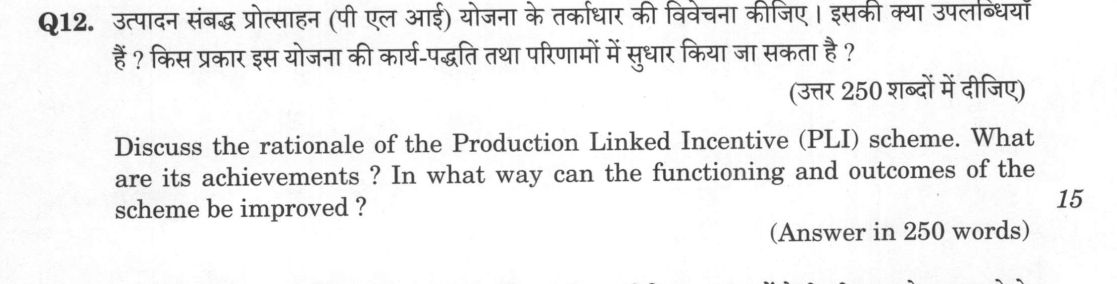
Discuss the rationale of the Production Linked Incentive (PLI) scheme. What are its achievements ? In what way can the…
Discuss the rationale of the Production Linked Incentive (PLI) scheme. What are its achievements ? In what way can the functioning and outcomes of the scheme be improved ? (Answer in 250 words) 15 marks
हिंदी में प्रश्न पढ़ें
उत्पादन संबद्ध प्रोत्साहन (पी एल आई) योजना के तर्कधार की विवेचना कीजिए। इसकी क्या उपलब्धियाँ हैं ? किस प्रकार इस योजना की कार्य-पद्धति तथा परिणामों में सुधार किया जा सकता है ? (उत्तर 250 शब्दों में दीजिए)
Model answer
Written by UPSC Answer Check against this question's marking rubric, to the 250-word length. UPSC does not publish answers for Mains — this is one way to score well, not an official key.
The Production Linked Incentive (PLI) scheme is a production-linked industrial policy that rewards incremental sales to build scale, quality and export competitiveness. Its rationale is to correct import dependence, especially on China, promote import substitution, attract FDI, anchor India in global value chains, generate employment, and support the $5 trillion economy target. It also seeks to raise quality standards, formalisation and domestic value addition.
Achievements are visible in electronics, where Apple-Foxconn and Samsung’s Noida expansion have made India a major iPhone producer, with about 14% of global output, and in pharmaceuticals, where API manufacturing has revived. Across sectors, over ₹2.5 lakh crore investments have been committed, with realised investment around ₹1.46 lakh crore by late 2024, and about 8.5 lakh direct and indirect jobs created. Sector-specific outcomes include mobile phones, APIs, textiles, food processing, auto components and solar PV modules, though performance is uneven.
Functioning can be improved by faster, transparent disbursement, clearer sunset clauses, stronger MSME inclusion, skill-development alignment, and building export competitiveness beyond subsidies. Critical gaps remain: limited backward integration in PLI sectors, thin upstream linkages such as semiconductors (addressed separately under the India Semiconductor Mission), persistent raw-material imports, uneven sectoral performance and environmental sustainability concerns.
Way forward should link PLI with PM MITRA parks, adopt design-led and R&D-linked incentives, embed circular-economy principles, and restructure support in a WTO-compliant manner. This can convert PLI from a production subsidy into a durable manufacturing ecosystem. The scheme’s success depends on converting committed capacity into operational plants, exports and skilled employment.
What "Discuss" is asking you to do
Lay the issue out from more than one side — how it arose, what is claimed for it, what is held against it, and where it now stands. UPSC attaches discuss to broad topics with several live dimensions, so coverage of the dimensions earns more than the strength of your opinion.
Structure that answers it
Set the issue up → the case as it is made → the case against → the dimension both sides leave out → where the balance now lies
Where marks are lost
Listing facts with no thread between them, or arguing one side throughout and calling it a discussion.
How this answer will be evaluated
Approach
Framework: Situation > Analysis > Measures > Assessment. discuss: intro > 3-4 dimensions > example > balanced close Full marks: Precise rationale, data-backed achievements, and implementable improvements
Key points expected
- Rationale: Atmanirbhar Bharat, supply chain diversification, global value chains
- Achievements: Specific sectoral growth (e.g., electronics, pharma) or FDI inflow
- Improvements: Addressing implementation bottlenecks or sectoral expansion
- Balanced close: Critical assessment of scheme's long-term viability
Evaluation rubric
Each sub-part is marked on its own, against the marks and word limit printed on the paper.
- The answer Rationale, achievements, and improvements for the PLI scheme · 250 words
discuss— intro → 3-4 dimensions → example → balanced close
Must cover
- Rationale: Atmanirbhar Bharat, supply chain diversification, global value chains
- Achievements: Specific sectoral growth (e.g., electronics, pharma) or FDI inflow
- Improvements: Addressing implementation bottlenecks or sectoral expansion
- Balanced close: Critical assessment of scheme's long-term viability
Loses marks
- Generic economic theory without PLI specifics
- Listing sectors without explaining the incentive mechanism
- Aspirational solutions without implementation details
Earns more
- Mentions specific sectors covered (e.g., 14 sectors)
- References 'Make in India' or 'Viksit Bharat' linkage
- Cites specific challenges like compliance or fund utilization
- Suggests specific policy tweaks (e.g., tiered incentives)
Extra mark
- Cites specific FDI or export growth figures for a PLI sector
- Mentions specific committee or report on PLI review
Practice this exact question
Write your answer and it is marked point by point against the model answer above — what you covered, what you missed, what you got wrong.
Evaluate my answer →More from General Studies 2025 GS Paper III
- Q9 Terrorism is a global scourge. How has it manifested in India ? Elaborate with contempora…
- Q10 The Government of India recently stated that Left Wing Extremism (LWE) will be eliminated…
- Q11 Explain how the Fiscal Health Index (FHI) can be used as a tool for assessing the fiscal…
- Q12 Discuss the rationale of the Production Linked Incentive (PLI) scheme. What are its achie…
- Q13 Examine the factors responsible for depleting groundwater in India. What are the steps ta…
- Q14 Examine the scope of the food processing industries in India. Elaborate the measures take…
- Q15 How does nanotechnology offer significant advancements in the field of agriculture ? How…