GS Paper III — Q2
What are the challenges before the Indian economy when the world is moving away from free trade and multilateralism to…
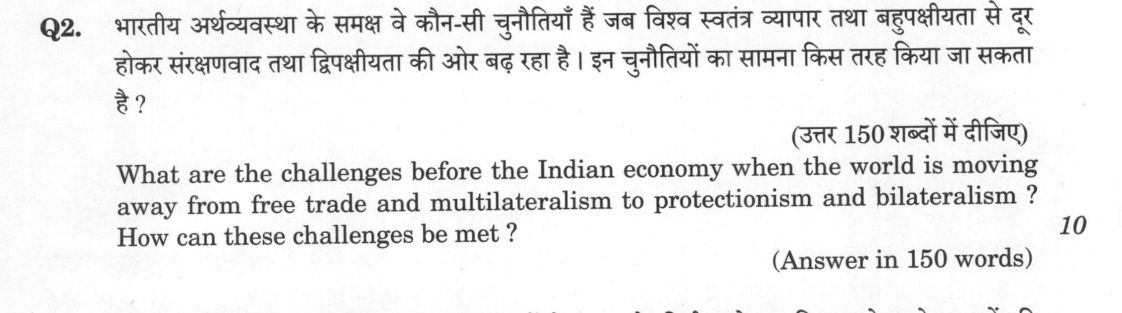
What are the challenges before the Indian economy when the world is moving away from free trade and multilateralism to protectionism and bilateralism ? How can these challenges be met ? (Answer in 150 words) 10 marks
हिंदी में प्रश्न पढ़ें
भारतीय अर्थव्यवस्था के समक्ष वे कौन-सी चुनौतियाँ हैं जब विश्व स्वतंत्र व्यापार तथा बहुपक्षीयता से दूर होकर संरक्षणवाद तथा द्विपक्षीयता की ओर बढ़ रहा है। इन चुनौतियों का सामना किस तरह किया जा सकता है ? (उत्तर 150 शब्दों में दीजिए)
Model answer
Written by UPSC Answer Check against this question's marking rubric, to the 150-word length. UPSC does not publish answers for Mains — this is one way to score well, not an official key.
Global geo-economic fragmentation and rising protectionism present critical headwinds for the Indian economy:
Challenges Before India First, escalating tariff barriers and the US-China trade war adversely impact Indian export competitiveness. Second, trade diversion from bilateral and mega-regional pacts threatens export displacement, visible in the competitive disadvantages following India’s exit from the Regional Comprehensive Economic Partnership (RCEP). Third, supply chain reconfiguration risks expose critical vulnerabilities in high-dependency sectors like semiconductors and pharmaceuticals. Fourth, the paralysis of the WTO Appellate Body erodes multilateral dispute settlement, leaving India vulnerable to unilateral trade measures.
Strategic Measures India must counter these disruptions by negotiating agile, comprehensive bilateral Free Trade Agreements (FTAs), expanding on recent pacts with the UAE and Australia while concluding negotiations with the UK and EU. Domestically, enhancing manufacturing competitiveness through Production Linked Incentive (PLI) schemes will fortify critical supply chains. Internationally, India must advocate for WTO reforms to revive rule-based multilateralism. Ultimately, policy must align with Atmanirbhar Bharat, balancing domestic self-reliance with strategic global integration.
What "What" is asking you to do
What is an interrogative rather than a command word. It opens a multi-part stem — what the thing is, then its causes, risks or remedies — and the definitional clause is the gate rather than the answer, with the marks spread across the clauses that follow it.
Structure that answers it
What it is, in two or three lines → the second clause of the stem, at length → the third clause, at length → a closing line only if room remains
Where marks are lost
Spending half the answer establishing the object and leaving the later clauses, which carry most of the marks, thinly answered.
How this answer will be evaluated
Approach
Framework: Situation > Analysis > Measures: legal, institutional, developmental > Assessment. challenges: 3-4 challenges > solutions mapped to them > conclusion Full marks: Identifies 3-4 specific challenges and maps implementable solutions to each with current data.
Key points expected
- Identify 3-4 distinct challenges (e.g., supply chain, exports, FDI).
- Map specific solutions to each identified challenge.
- Solutions must be implementable (legal/institutional), not aspirational.
- Contextualize the shift from multilateralism to bilateralism.
Evaluation rubric
Each sub-part is marked on its own, against the marks and word limit printed on the paper.
- The answer Identify 3-4 specific economic challenges of the shift to protectionism and map implementable solutions to them. · 150 words
challenges— 3-4 challenges → solutions mapped to them → conclusion
Must cover
- Identify 3-4 distinct challenges (e.g., supply chain, exports, FDI).
- Map specific solutions to each identified challenge.
- Solutions must be implementable (legal/institutional), not aspirational.
- Contextualize the shift from multilateralism to bilateralism.
Loses marks
- Generic 'newspaper summary' style without specific analysis.
- Solutions that are aspirational rather than implementable.
- Ignoring the 'bilateralism' aspect of the question.
Earns more
- Mention of specific sectors (e.g., IT, pharma, agriculture).
- Reference to specific trade agreements (e.g., RCEP, CPTPP).
- Discussion of 'China Plus One' strategy.
Extra mark
- One current scheme with a number (e.g., PLI scheme amount).
- Simple flowchart of supply chain diversification.
Practice this exact question
Write your answer and it is marked point by point against the model answer above — what you covered, what you missed, what you got wrong.
Evaluate my answer →More from General Studies 2025 GS Paper III
- Q1 Distinguish between the Human Development Index (HDI) and the Inequality-adjusted Human D…
- Q2 What are the challenges before the Indian economy when the world is moving away from free…
- Q3 Explain the factors influencing the decision of the farmers on the selection of high valu…
- Q4 Elaborate the scope and significance of supply chain management of agricultural commoditi…
- Q5 The fusion energy programme in India has steadily evolved over the past few decades. Ment…