GS Paper III — Q17
Mineral resources are fundamental to the country's economy and these are exploited by mining. Why is mining considered an…
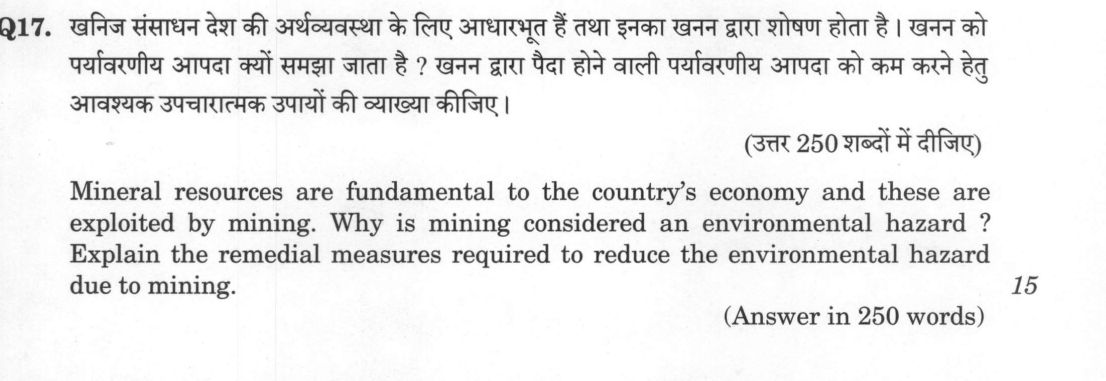
Mineral resources are fundamental to the country's economy and these are exploited by mining. Why is mining considered an environmental hazard ? Explain the remedial measures required to reduce the environmental hazard due to mining. (Answer in 250 words) 15 marks
हिंदी में प्रश्न पढ़ें
खनिज संसाधन देश की अर्थव्यवस्था के लिए आधारभूत हैं तथा इनका खनन द्वारा शोषण होता है। खनन को पर्यावरणीय आपदा क्यों समझा जाता है ? खनन द्वारा पैदा होने वाली पर्यावरणीय आपदा को कम करने हेतु आवश्यक उपचारात्मक उपायों की व्याख्या कीजिए। (उत्तर 250 शब्दों में दीजिए)
Model answer
Written by UPSC Answer Check against this question's marking rubric, to the 250-word length. UPSC does not publish answers for Mains — this is one way to score well, not an official key.
Mining drives industrialization and infrastructure, contributing vital raw materials to India's economy. However, unscientific and intensive extraction causes severe ecological disruption through distinct causal pathways.
Causes of Environmental Hazard
Land Degradation: Topsoil removal and excavation in open-cast mining cause extensive deforestation and permanently destroy agricultural productivity. Underground mining destabilizes geological strata, triggering land subsidence and surface collapse.
Water Pollution and Depletion: Exposure of excavated sulfide minerals to air and water generates Acid Mine Drainage (AMD), which leaches toxic heavy metals like arsenic and mercury into rivers and aquifers. Massive dewatering for deep mining lowers water tables, depriving local communities of potable water.
Air Pollution: Drilling, blasting, and haulage release massive loads of particulate matter (PM₂.5, PM₁₀) and toxic coal dust. In intensive belts like Jharia and Dhanbad, persistent fugitive emissions cause severe chronic respiratory illnesses among populations.
Biodiversity Loss: Mining activities fragment critical wildlife corridors and destroy habitats in ecologically sensitive zones, including the Western Ghats, the Aravallis, and the Northeast, threatening endemic flora and fauna.
Remedial Measures
Ecological and Operational Interventions: Rigorous compliance with Environmental Impact Assessments (EIA) must govern all project life cycles. Implementing progressive mine closure alongside active extraction facilitates concurrent bio-reclamation of overburden dumps using native vegetation. Deploying cleaner extraction technologies, such as continuous surface miners and zero-liquid-discharge effluent treatment plants, curbs particulate emissions and Acid Mine Drainage.
Legal and Institutional Frameworks: The Indian Bureau of Mines (IBM) must strictly enforce the Sustainable Development Framework (SDF) alongside the Star Rating system to incentivize ecological compliance. Furthermore, the MMDR Act, 2015, mandates utilizing District Mineral Foundation (DMF) funds to finance environmental remediation, watershed restoration, and community healthcare.
Adopting green mining techniques and circular economy principles is essential to harmonize mineral extraction with long-term ecological sustainability.
What "Explain" is asking you to do
Make the working of something clear — what sets it off, what follows from what, and what it produces. Explain is the Commission's mechanism word: it dominates the technical papers and the “explain why” stems, where the marks sit in the causal chain and not in the label.
Structure that answers it
State what it is → the initiating condition → the chain of cause, step by step → an instance where it plays out → what the chain produces
Where marks are lost
Describing what something looks like instead of why it works that way. Naming the stages without linking them reads as description too.
How this answer will be evaluated
Approach
Framework: Situation > Analysis > Measures: legal, institutional, developmental > Assessment. explain: definition/context > points in order > small example > short close Full marks: Comprehensive analysis of hazards with specific, implementable remedial measures and legal references.
Key points expected
- Identify specific hazards: land degradation, water pollution, air quality
- Explain the mechanism of environmental damage (e.g., tailings, dust)
- List remedial measures: legal (Mines Act), institutional, developmental
- Mention specific mitigation: afforestation, water treatment, waste management
Evaluation rubric
Each sub-part is marked on its own, against the marks and word limit printed on the paper.
- The answer Define mining as an environmental hazard and detail remedial measures to mitigate its impact. · 250 words
explain— definition/context → points in order → small example → short close
Must cover
- Identify specific hazards: land degradation, water pollution, air quality
- Explain the mechanism of environmental damage (e.g., tailings, dust)
- List remedial measures: legal (Mines Act), institutional, developmental
- Mention specific mitigation: afforestation, water treatment, waste management
Loses marks
- Vague generalities without specific mining hazards
- Measures that are aspirational rather than implementable
- Ignoring the 'why' and only listing 'what'
Earns more
- Reference to specific environmental laws (e.g., EIA Notification)
- Mention of specific technologies for waste management
- Discussion of post-mining land reclamation
- Reference to specific mining hazards (e.g., acid mine drainage)
Extra mark
- Citing a specific case study of successful remediation
- Mentioning specific government schemes for mine closure
Practice this exact question
Write your answer and it is marked point by point against the model answer above — what you covered, what you missed, what you got wrong.
Evaluate my answer →More from General Studies 2025 GS Paper III
- Q14 Examine the scope of the food processing industries in India. Elaborate the measures take…
- Q15 How does nanotechnology offer significant advancements in the field of agriculture ? How…
- Q16 India aims to become a semiconductor manufacturing hub. What are the challenges faced by…
- Q17 Mineral resources are fundamental to the country's economy and these are exploited by min…
- Q18 Write a review on India's climate commitments under the Paris Agreement (2015) and mentio…
- Q19 What are the major challenges to internal security and peace process in the North-Eastern…
- Q20 Why is maritime security vital to protect India's sea trade ? Discuss maritime and coasta…