GS Paper III — Q11
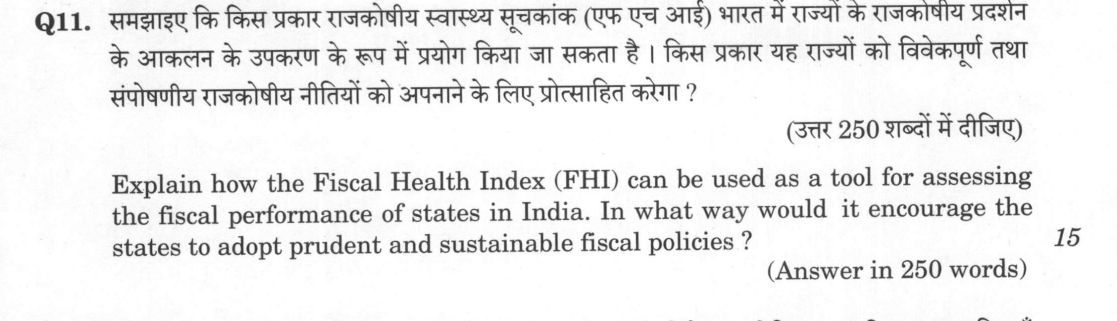
Explain how the Fiscal Health Index (FHI) can be used as a tool for assessing the fiscal performance of states in India. In what…
Explain how the Fiscal Health Index (FHI) can be used as a tool for assessing the fiscal performance of states in India. In what way would it encourage the states to adopt prudent and sustainable fiscal policies ? (Answer in 250 words) 15 marks
हिंदी में प्रश्न पढ़ें
समझाइए कि किस प्रकार राजकोषीय स्वास्थ्य सूचकांक (एफ एच आई) भारत में राज्यों के राजकोषीय प्रदर्शन के आकलन के उपकरण के रूप में प्रयोग किया जा सकता है। किस प्रकार यह राज्यों को विवेकपूर्ण तथा संपोषणीय राजकोषीय नीतियों को अपनाने के लिए प्रोत्साहित करेगा ? (उत्तर 250 शब्दों में दीजिए)
Model answer
Written by UPSC Answer Check against this question's marking rubric, to the 250-word length. UPSC does not publish answers for Mains — this is one way to score well, not an official key.
The Fiscal Health Index (FHI) is a composite index, released by NITI Aayog, that converts state budget and finance-account data into a fiscal scorecard. It compares states on five parameters—debt, deficit, revenue mobilisation, expenditure quality and fiscal capacity—using indicators such as gross debt to GSDP, interest payments to revenue receipts, fiscal deficit to GSDP, own tax revenue growth, capital expenditure as a share of total expenditure, and revenue per capita. Ranking states enables benchmarking, like NITI Aayog’s State Energy & Climate Index or RBI’s State Finances Report.
The FHI influences behaviour through transparency and incentives. When a state’s debt-to-GSDP or interest burden is high, the ranking signals weak fiscal capacity, which can raise bond yields and borrowing costs. It can also affect the Centre’s decisions on conditional grants, loans and fiscal transfers, because better-ranked states appear lower-risk. This creates competitive federalism: states improve tax administration, reduce revenue deficits and shift spending toward capital works to climb the index.
However, the FHI is not a complete diagnostic. It depends on reported budget data, with data lag, so it may miss off-budget borrowings or contingent liabilities; uniform weightage may not fully reflect states with different resource bases, demographic burdens or disaster exposure. It should therefore be read alongside RBI reports, state finance commissions and reforms such as debt management policies and stronger public financial management. Used as a benchmark rather than a target, the FHI can encourage prudent, sustainable fiscal policies without distorting essential social spending.
What "Explain" is asking you to do
Make the working of something clear — what sets it off, what follows from what, and what it produces. Explain is the Commission's mechanism word: it dominates the technical papers and the “explain why” stems, where the marks sit in the causal chain and not in the label.
Structure that answers it
State what it is → the initiating condition → the chain of cause, step by step → an instance where it plays out → what the chain produces
Where marks are lost
Describing what something looks like instead of why it works that way. Naming the stages without linking them reads as description too.
How this answer will be evaluated
Approach
Framework: Economy: carry live data, draw the simple diagram. explain: definition/context > points in order > small example > short close Full marks: Precise definition, clear list of parameters, and a logical link to policy incentives.
Key points expected
- Define FHI as a composite index of fiscal health
- List key parameters (e.g., debt, revenue, expenditure)
- Explain the mechanism of ranking states
- Link FHI to adoption of sustainable policies
Evaluation rubric
Each sub-part is marked on its own, against the marks and word limit printed on the paper.
- The answer Define FHI, list its parameters, and explain how it incentivizes fiscal prudence. · 250 words
explain— definition/context → points in order → small example → short close
Must cover
- Define FHI as a composite index of fiscal health
- List key parameters (e.g., debt, revenue, expenditure)
- Explain the mechanism of ranking states
- Link FHI to adoption of sustainable policies
Loses marks
- Confusing FHI with the Fiscal Responsibility Act
- Listing parameters without explaining their weight
- Ignoring the incentive mechanism entirely
Earns more
- Mention specific parameters like capital expenditure
- Reference the 14th Finance Commission
- Discuss the 'naming and shaming' effect
- Mention the link to central transfers
Extra mark
- Cite a specific state's FHI score
- Reference the 15th Finance Commission changes
Practice this exact question
Write your answer and it is marked point by point against the model answer above — what you covered, what you missed, what you got wrong.
Evaluate my answer →More from General Studies 2025 GS Paper III
- Q8 Seawater intrusion in the coastal aquifers is a major concern in India. What are the caus…
- Q9 Terrorism is a global scourge. How has it manifested in India ? Elaborate with contempora…
- Q10 The Government of India recently stated that Left Wing Extremism (LWE) will be eliminated…
- Q11 Explain how the Fiscal Health Index (FHI) can be used as a tool for assessing the fiscal…
- Q12 Discuss the rationale of the Production Linked Incentive (PLI) scheme. What are its achie…
- Q13 Examine the factors responsible for depleting groundwater in India. What are the steps ta…
- Q14 Examine the scope of the food processing industries in India. Elaborate the measures take…