GS Paper III — Q18
Write a review on India's climate commitments under the Paris Agreement (2015) and mention how these have been further…
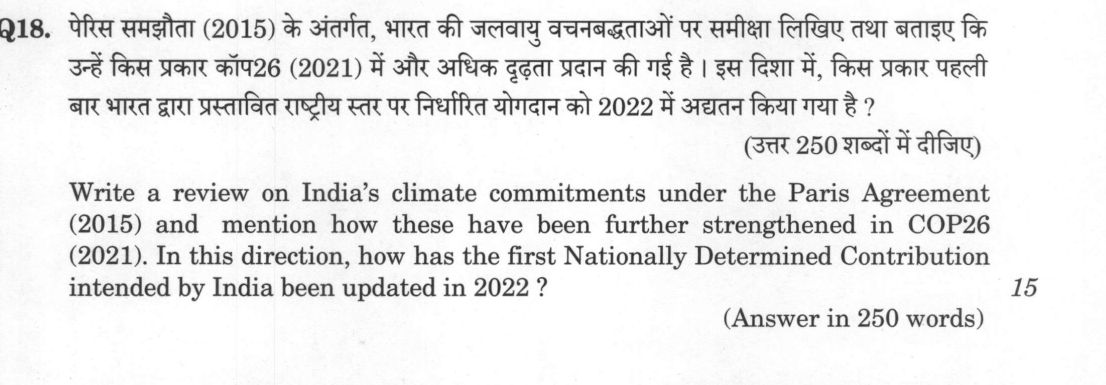
Write a review on India's climate commitments under the Paris Agreement (2015) and mention how these have been further strengthened in COP26 (2021). In this direction, how has the first Nationally Determined Contribution intended by India been updated in 2022 ? (Answer in 250 words) 15 marks
हिंदी में प्रश्न पढ़ें
पेरिस समझौता (2015) के अंतर्गत, भारत की जलवायु वचनबद्धताओं पर समीक्षा लिखिए तथा बताइए कि उन्हें किस प्रकार कोप26 (2021) में और अधिक दृढ़ता प्रदान की गई है। इस दिशा में, किस प्रकार पहली बार भारत द्वारा प्रस्तावित राष्ट्रीय स्तर पर निर्धारित योगदान को 2022 में अद्यतन किया गया है ? (उत्तर 250 शब्दों में दीजिए)
Model answer
Written by UPSC Answer Check against this question's marking rubric, to the 250-word length. UPSC does not publish answers for Mains — this is one way to score well, not an official key.
India’s Paris commitments show a shift from intensity-based mitigation to a more ambitious, but selectively quantified, climate trajectory. Under the 2015 NDC, India pledged to reduce emission intensity of GDP by 33–35% by 2030 from 2005 levels, achieve 40% non-fossil fuel energy capacity, and create an additional carbon sink of 2.5–3 billion tonnes CO2e through forests and land use. These targets were credible but largely relative, leaving absolute emissions and long-term decarbonisation open.
At COP26, India strengthened its stance through Panchamrit: net zero by 2070, 500 GW non-renewable energy capacity by 2030, a 1-billion-tonne reduction in projected carbon emissions, a 45% reduction in emission intensity, and 50% of energy needs from renewables. This marked a clear rise in ambition, linking near-term capacity expansion with a long-term net-zero pathway.
India’s first NDC was updated in 2022 by formalising part of this shift: the emission-intensity target was raised to 45% by 2030 and the non-fossil fuel capacity share to 50%, while the word “additional” was removed from the carbon-sink target, creating ambiguity. However, the updated NDC did not incorporate the 500 GW non-renewable target or the 1-billion-tonne absolute reduction, nor did it make net zero by 2070 an NDC target; that remains a COP26/LTLED commitment. Implementation relies on National Adaptation Communication, SAPCCs and sectoral missions. This partial translation of political ambition into submitted targets is the key limitation.
Thus, India’s trajectory is coherent and increasingly ambitious, but the NDC update remains narrower than COP26 rhetoric, requiring stronger absolute targets and transparent sink accounting.
What "Review" is asking you to do
Track something across its life and report where it has reached — what it was meant to do, what has happened since, what is still outstanding. Review attaches to institutions and commitments, so the answer is a present-state verdict supported by the record.
Structure that answers it
Scope and period → the original intent → what has happened since → what remains undone → present-state verdict
Where marks are lost
Writing a history when the question wants a present-state verdict, or stopping at what was promised without saying what has actually been delivered.
How this answer will be evaluated
Approach
Framework: Situation > Analysis > Measures: legal, institutional, developmental > Assessment. discuss: intro > 3-4 dimensions > example > balanced close Full marks: Precise comparison of 2015 vs 2021 vs 2022 targets with specific percentages.
Key points expected
- Paris 2015: 40% reduction in carbon intensity by 2030
- Paris 2015: 40% non-fossil fuel capacity by 2030
- COP26 2021: Net Zero by 2070
- 2022 NDC: 45% reduction in carbon intensity by 2030
- 2022 NDC: 50% non-fossil fuel capacity by 2030
Evaluation rubric
Each sub-part is marked on its own, against the marks and word limit printed on the paper.
- The answer Review Paris 2015 commitments, COP26 2021 strengthening, and 2022 NDC update. 15 marks · 250 words
discuss— intro → 3-4 dimensions → example → balanced close
Must cover
- Paris 2015: 40% reduction in carbon intensity by 2030
- Paris 2015: 40% non-fossil fuel capacity by 2030
- COP26 2021: Net Zero by 2070 commitment
- 2022 NDC: 45% reduction in carbon intensity by 2030
Loses marks
- Vague generalities without specific percentage targets
- Confusing 2015 NDC targets with 2022 updated targets
- Ignoring the specific year of the NDC update (2022)
Earns more
- COP26: 50% non-fossil fuel capacity by 2030
- 2022 NDC: 50% non-fossil fuel capacity by 2030
- Mention of 100 GW solar and 60 GW wind targets
- Reference to 100% renewable energy by 2070
Extra mark
- Mention of 50% of total energy from renewables by 2030
- Reference to 100% electric vehicle sales by 2030
Practice this exact question
Write your answer and it is marked point by point against the model answer above — what you covered, what you missed, what you got wrong.
Evaluate my answer →More from General Studies 2025 GS Paper III
- Q15 How does nanotechnology offer significant advancements in the field of agriculture ? How…
- Q16 India aims to become a semiconductor manufacturing hub. What are the challenges faced by…
- Q17 Mineral resources are fundamental to the country's economy and these are exploited by min…
- Q18 Write a review on India's climate commitments under the Paris Agreement (2015) and mentio…
- Q19 What are the major challenges to internal security and peace process in the North-Eastern…
- Q20 Why is maritime security vital to protect India's sea trade ? Discuss maritime and coasta…