GS Paper III — Q5
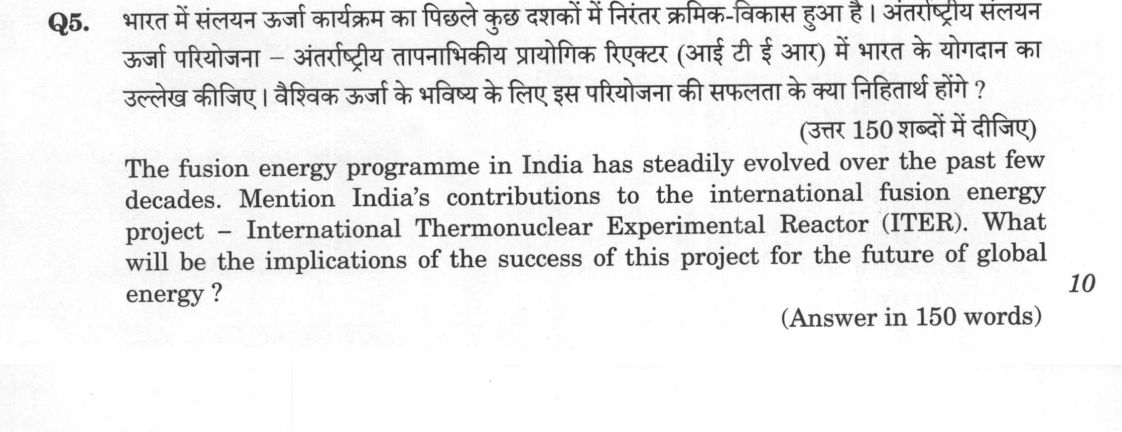
The fusion energy programme in India has steadily evolved over the past few decades. Mention India's contributions to the…
The fusion energy programme in India has steadily evolved over the past few decades. Mention India's contributions to the international fusion energy project – International Thermonuclear Experimental Reactor (ITER). What will be the implications of the success of this project for the future of global energy ? (Answer in 150 words) 10 marks
हिंदी में प्रश्न पढ़ें
भारत में संलयन ऊर्जा कार्यक्रम का पिछले कुछ दशकों में निरंतर क्रमिक-विकास हुआ है। अंतर्राष्ट्रीय संलयन ऊर्जा परियोजना – अंतर्राष्ट्रीय तापनाभिकीय प्रायोगिक रिएक्टर (आई टी ई आर) में भारत के योगदान का उल्लेख कीजिए। वैश्विक ऊर्जा के भविष्य के लिए इस परियोजना की सफलता के क्या निहितार्थ होंगे ? (उत्तर 150 शब्दों में दीजिए)
Model answer
Written by UPSC Answer Check against this question's marking rubric, to the 150-word length. UPSC does not publish answers for Mains — this is one way to score well, not an official key.
India's role in ITER is concentrated in advanced cryogenics, plasma diagnostics, heating and materials testing. IPR, Gandhinagar, leads India's in-kind contribution, supplying high-technology cryogenic cooling systems and cryo-distribution components for ITER's superconducting magnets and cryoplant in the 4.5 K/80 K regime, along with heating-system elements and tritium-handling expertise. This builds on India's domestic tokamak experience, from SST-1 to the Aditya-U upgrades, strengthening indigenous plasma, cryogenic and high-voltage engineering. India's participation validates its ability to deliver mission-critical systems on international timelines and builds institutional credibility for future fusion projects.
Success of ITER would demonstrate carbon-neutral baseload fusion power, reducing fossil-fuel dependence and supporting climate goals. For developing nations, it can improve energy security by offering a low-carbon, fuel-diversified option. Strategically, it will transfer high-technology know-how, create domestic supply chains, and position India in global clean-energy diplomacy. Thus, ITER success would make fusion a credible pillar of the future global energy mix.
What "Mention" is asking you to do
Put specific factual content on record — the names, features, targets or instances the stem asks for. Mention is usually the subordinate half of a larger question, so it must be done fully but quickly, leaving room for the part that carries the main directive.
Structure that answers it
The items named directly, without preamble → one qualifying detail against each → straight on to the part of the stem the marks actually sit in
Where marks are lost
Gesturing at the category instead of naming the particulars, or expanding it until the analytical half of the question is squeezed.
How this answer will be evaluated
Approach
Framework: GS3 Technology: why it matters, use, benefit, risk, policy. explain: definition/context > points in order > small example > short close Full marks: Precise details on India's 9% share/TF coil + clear link to climate goals.
Key points expected
- Identify India as one of the 7 member states
- Mention specific contribution (e.g., 9% cost share, TF coil manufacturing)
- State benefit: virtually limitless, clean energy source
- State benefit: reduction in carbon emissions/climate change
Evaluation rubric
Each sub-part is marked on its own, against the marks and word limit printed on the paper.
- The answer Define India's specific role in ITER and analyze the global energy implications of its success. 10 marks · 150 words
explain— definition/context → points in order → small example → short close
Must cover
- Identify India as one of the 7 member states
- Mention specific contribution (e.g., 9% cost share, TF coil manufacturing)
- State benefit: virtually limitless, clean energy source
- State benefit: reduction in carbon emissions/climate change
Loses marks
- Confusing fusion with fission (nuclear power)
- Vague generalities without specific ITER details
- Ignoring the 'implications' part of the question
Earns more
- Mention 'fuel' aspect (Deuterium/Tritium availability)
- Mention 'safety' aspect (no meltdown risk)
- Reference to India's domestic fusion program (IFEC)
Extra mark
- Mention specific Indian contribution: Toroidal Field (TF) coil
- Mention specific location: ITER site in France
Practice this exact question
Write your answer and it is marked point by point against the model answer above — what you covered, what you missed, what you got wrong.
Evaluate my answer →More from General Studies 2025 GS Paper III
- Q2 What are the challenges before the Indian economy when the world is moving away from free…
- Q3 Explain the factors influencing the decision of the farmers on the selection of high valu…
- Q4 Elaborate the scope and significance of supply chain management of agricultural commoditi…
- Q5 The fusion energy programme in India has steadily evolved over the past few decades. Ment…
- Q6 How can India achieve energy independence through clean technology by 2047 ? How can biot…
- Q7 What is Carbon Capture, Utilization and Storage (CCUS) ? What is the potential role of CC…
- Q8 Seawater intrusion in the coastal aquifers is a major concern in India. What are the caus…