GS Paper III — Q19
What are the major challenges to internal security and peace process in the North-Eastern States ? Map the various peace accords…
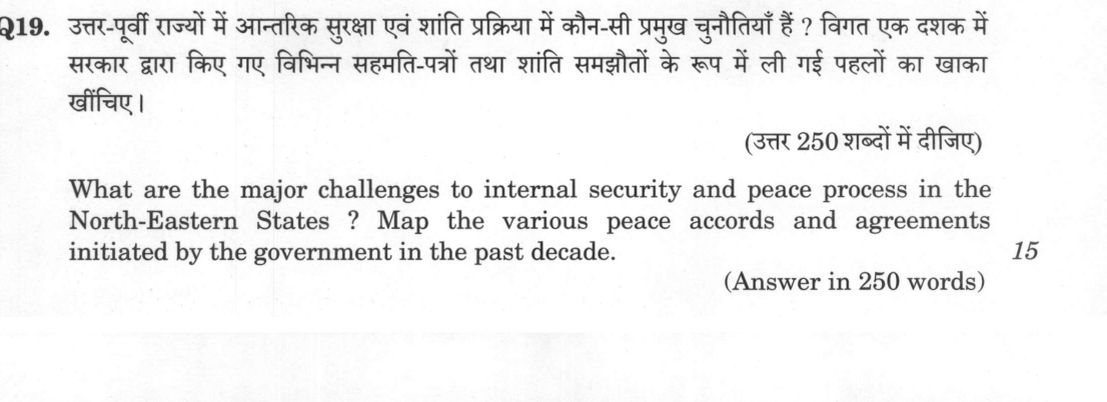
What are the major challenges to internal security and peace process in the North-Eastern States ? Map the various peace accords and agreements initiated by the government in the past decade. (Answer in 250 words) 15 marks
हिंदी में प्रश्न पढ़ें
उत्तर-पूर्वी राज्यों में आन्तरिक सुरक्षा एवं शांति प्रक्रिया में कौन-सी प्रमुख चुनौतियाँ हैं ? विगत एक दशक में सरकार द्वारा किए गए विभिन्न सहमति-पत्रों तथा शांति समझौतों के रूप में ली गई पहलों का खाका खींचिए। (उत्तर 250 शब्दों में दीजिए)
Model answer
Written by UPSC Answer Check against this question's marking rubric, to the 250-word length. UPSC does not publish answers for Mains — this is one way to score well, not an official key.
The North-East’s internal security and peace processes are mutually reinforcing: unresolved identity, border and development grievances sustain armed conflict, while accords test whether political settlement can outpace violence.
Challenges Ethnic fragmentation and competing sub-nationalisms create overlapping claims. Naga-Kuki-Meitei tensions in Manipur—chiefly Meitei-Kuki-Zo today, with Naga-Kuki border frictions—show how one community’s claim can trigger another’s. Cross-border linkages with Myanmar and Bangladesh allow insurgents to regroup, trade and evade; Operation Sunrise targeted Myanmar-based camps, while the Free Movement Regime complicates border control—its suspension is a restrictive measure but may breed local resentment. Small-arms proliferation, IEDs and narco-terrorism finance sustain groups. Structural deficits persist: AFSPA’s continued presence, uneven development, and demographic anxieties over illegal migration deepen mistrust.
Accords Post-2014 government accords map a shift from war to negotiation: the 2015 Naga Framework Agreement remains unresolved despite peace talks; the 2020 Bodo Peace Accord and Bru-Reang Agreement addressed long-standing insurgencies; the 2022 Assam-Meghalaya border pact eased inter-state friction. Yet several accords lack full disarmament, institutional implementation and local ownership, producing “peace accords without disarmament” and renewed violence. When accords are signed without addressing these structural deficits, armed groups retain leverage, and ethnic grievances re-emerge as local violence, undermining the peace process. Conversely, security operations alone cannot settle identity disputes; they must be paired with political inclusion and economic opportunity.
A durable settlement requires sequenced disarmament, credible implementation bodies, targeted development and employment, coordinated border management with Myanmar and Bangladesh, and community reconciliation in Manipur. Only then can accords convert ceasefire into stable peace.
What "Analyse" is asking you to do
Break the subject into its working parts and show how they act on each other. The marks are in the interconnections — which factor drives which, and what the resulting structure explains — not in the inventory of factors.
Structure that answers it
Define the whole → separate it into its parts → show which part drives which → what that interaction produces → what the structure implies
Where marks are lost
A flat list of causes with no account of which drives which. An answer of neatly separated headings, each self-contained, scores as description.
How this answer will be evaluated
Approach
Framework: Security: classify threat, vulnerability, response; stay calm. challenges: 3-4 challenges > solutions mapped to them > conclusion Full marks: Identifies specific challenges, maps recent accords accurately, and links them to security/development.
Key points expected
- Identify 3-4 specific internal security challenges in NE states
- Map peace accords/agreements initiated in the past decade
- Link specific challenges to the peace process
- Provide a balanced conclusion on the current status
Evaluation rubric
Each sub-part is marked on its own, against the marks and word limit printed on the paper.
- The answer Identify 3-4 major internal security challenges and map peace accords/agreements from the past decade. · 250 words
challenges— 3-4 challenges → solutions mapped to them → conclusion
Must cover
- Identify 3-4 specific internal security challenges in NE states
- Map peace accords/agreements initiated in the past decade
- Link specific challenges to the peace process
- Provide a balanced conclusion on the current status
Loses marks
- Vague generalities without specific NE state examples
- Listing accords without linking them to challenges
- Ignoring the 'past decade' timeframe for accords
Earns more
- Mention specific challenges like insurgency, terrorism, or border issues
- Name specific peace accords (e.g., Bodo, Naga, ULFA)
- Discuss the role of developmental measures in peace
- Reference specific government initiatives or committees
Extra mark
- Cite specific dates of peace accords
- Mention specific government schemes for NE development
Practice this exact question
Write your answer and it is marked point by point against the model answer above — what you covered, what you missed, what you got wrong.
Evaluate my answer →More from General Studies 2025 GS Paper III
- Q16 India aims to become a semiconductor manufacturing hub. What are the challenges faced by…
- Q17 Mineral resources are fundamental to the country's economy and these are exploited by min…
- Q18 Write a review on India's climate commitments under the Paris Agreement (2015) and mentio…
- Q19 What are the major challenges to internal security and peace process in the North-Eastern…
- Q20 Why is maritime security vital to protect India's sea trade ? Discuss maritime and coasta…