GS Paper III — Q20
Why is maritime security vital to protect India's sea trade ? Discuss maritime and coastal security challenges and the way…
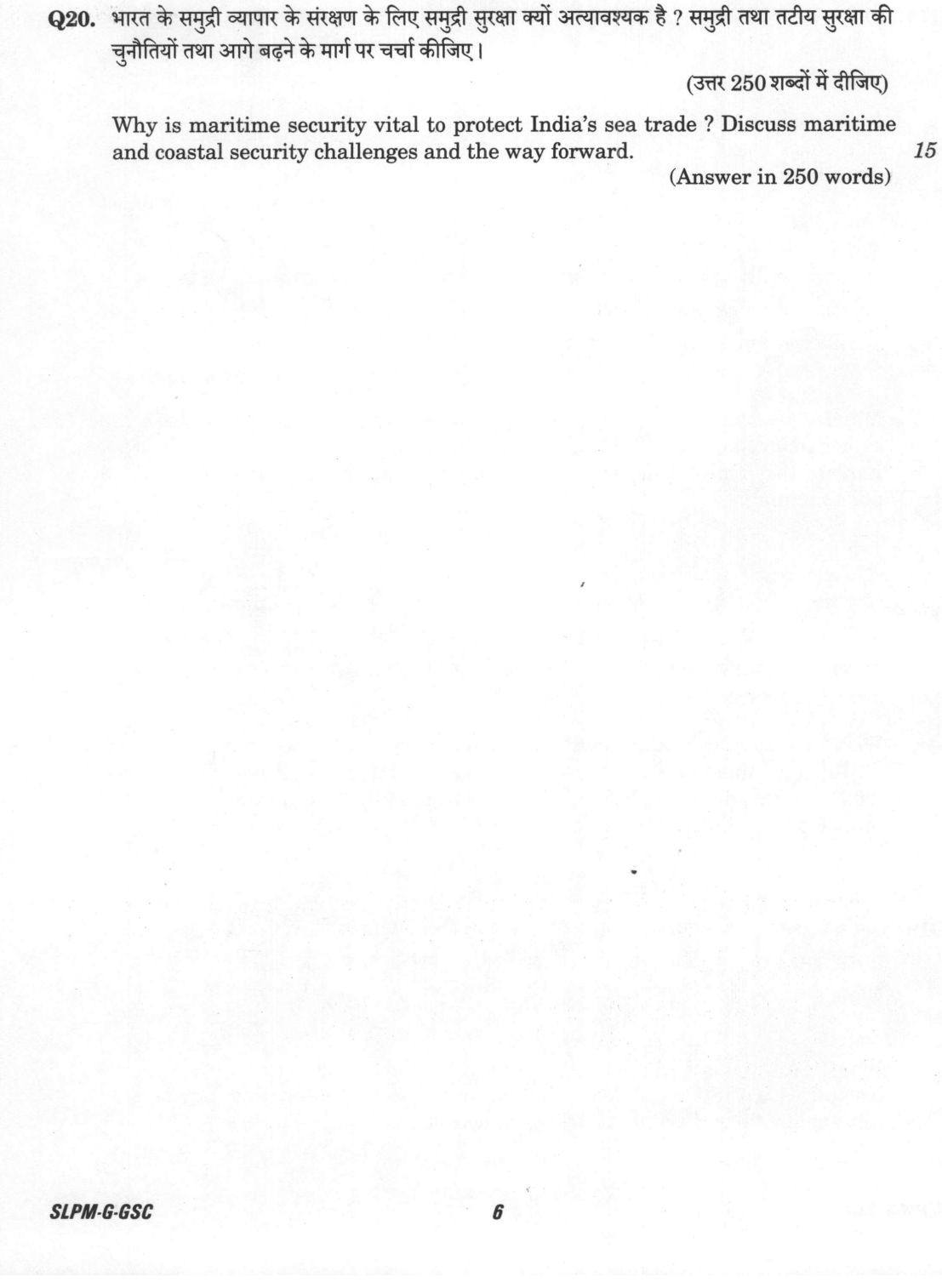
Why is maritime security vital to protect India's sea trade ? Discuss maritime and coastal security challenges and the way forward. (Answer in 250 words) 15 marks
हिंदी में प्रश्न पढ़ें
भारत के समुद्री व्यापार के संरक्षण के लिए समुद्री सुरक्षा क्यों अत्यावश्यक है ? समुद्री तथा तटीय सुरक्षा की चुनौतियों तथा आगे बढ़ने के मार्ग पर चर्चा कीजिए । (उत्तर 250 शब्दों में दीजिए)
Model answer
Written by UPSC Answer Check against this question's marking rubric, to the 250-word length. UPSC does not publish answers for Mains — this is one way to score well, not an official key.
With a 7,516 km coastline, over 90% of India’s international trade by volume (70% by value) and more than 80% of crude oil imports transit the Indian Ocean Sea Lines of Communication (SLOCs) through critical chokepoints like the Straits of Hormuz and Malacca. Ensuring an unhindered maritime environment is therefore indispensable for India’s energy security, export competitiveness, and sustained economic growth.
Maritime and Coastal Security Challenges
- Non-Traditional Threats: Resurgent piracy in the Gulf of Aden, maritime terrorism (evidenced by the 26/11 Mumbai attacks), narcotics and arms smuggling, and Illegal, Unreported, and Unregulated (IUU) fishing threaten commercial lanes.
- Strategic & Grey-Zone Threats: China’s expanding presence through the "String of Pearls" strategy, dual-use port infrastructure, and regular PLA Navy submarine deployments contest India’s primary area of interest.
- Coastal Vulnerabilities: India's coastal borders, particularly along Sir Creek and the Sundarbans, remain porous. Tracking thousands of small fishing vessels lacking transponders, securing numerous uninhabited islands in the Andaman & Nicobar and Lakshadweep archipelagos, and bridging coordination gaps among state marine police forces pose persistent operational hurdles.
The Way Forward
- Strengthening Domain Awareness: Expedite the National Maritime Domain Awareness (NMDA) project and expand the Coastal Surveillance Network (CSN) alongside the Indian Navy’s Information Management and Analysis Centre (IMAC).
- Regional Cooperation: Leverage the SAGAR (Security and Growth for All in the Region) framework, expand White Shipping Information agreements, and deepen security architecture via IORA and BIMSTEC.
- Grassroots & Physical Capacity: Mobilize coastal fishing communities as eyes and ears through the Sagar Rakshak Dal, mandate satellite transponders on all mechanized boats, and scale up indigenous naval shipbuilding to harmonize national security with blue economy goals.
What "Discuss" is asking you to do
Lay the issue out from more than one side — how it arose, what is claimed for it, what is held against it, and where it now stands. UPSC attaches discuss to broad topics with several live dimensions, so coverage of the dimensions earns more than the strength of your opinion.
Structure that answers it
Set the issue up → the case as it is made → the case against → the dimension both sides leave out → where the balance now lies
Where marks are lost
Listing facts with no thread between them, or arguing one side throughout and calling it a discussion.
How this answer will be evaluated
Approach
Framework: Security: classify threat, vulnerability, response; stay calm. discuss: intro > 3-4 dimensions > example > balanced close Full marks: Precise economic linkage, specific threat classification, and implementable institutional measures.
Key points expected
- Link security to 90% trade volume and energy imports
- Classify threats: piracy, terrorism, illegal fishing, smuggling
- Identify vulnerabilities: EEZ gaps, coastal state coordination
- Propose measures: SAGAR, INS, port security, international cooperation
Evaluation rubric
Each sub-part is marked on its own, against the marks and word limit printed on the paper.
- The answer Explain the economic necessity of maritime security and analyze specific threats and solutions. 15 marks · 250 words
discuss— intro → 3-4 dimensions → example → balanced close
Must cover
- Link security to 90% trade volume and energy imports
- Classify threats: piracy, terrorism, illegal fishing, smuggling
- Identify vulnerabilities: EEZ gaps, coastal state coordination
- Propose measures: SAGAR, INS, port security, international cooperation
Loses marks
- Generic 'security is important' without economic context
- Ignoring coastal security (smuggling/illegal fishing)
- Aspirational solutions without institutional mechanism
Earns more
- Mention specific chokepoints (Malacca, Hormuz, Bab-el-Mandeb)
- Reference specific agencies (Coast Guard, Navy, CUSMA)
- Discuss non-traditional threats (climate, undersea cables)
- Mention specific initiatives (SAGAR, IOR-ARC)
Extra mark
- Cite specific incident (e.g., 2008 Mumbai, 2019 tanker)
- Reference specific treaty (UNCLOS, IMO conventions)
Practice this exact question
Write your answer and it is marked point by point against the model answer above — what you covered, what you missed, what you got wrong.
Evaluate my answer →More from General Studies 2025 GS Paper III
- Q17 Mineral resources are fundamental to the country's economy and these are exploited by min…
- Q18 Write a review on India's climate commitments under the Paris Agreement (2015) and mentio…
- Q19 What are the major challenges to internal security and peace process in the North-Eastern…
- Q20 Why is maritime security vital to protect India's sea trade ? Discuss maritime and coasta…