GS Paper III — Q15
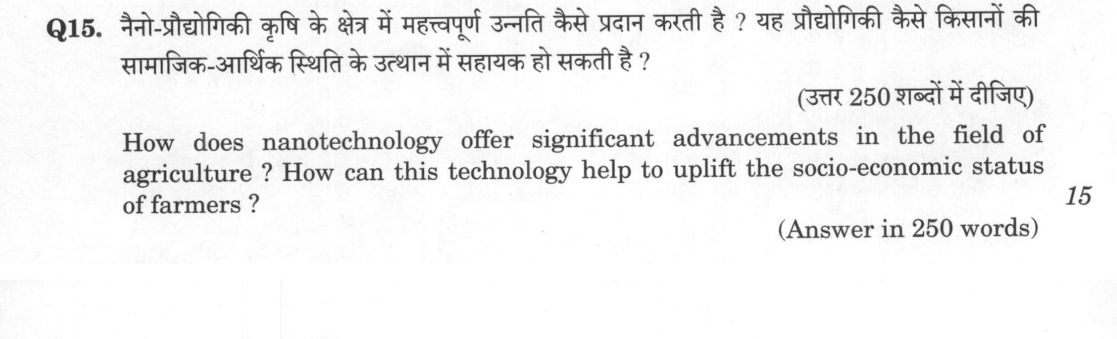
How does nanotechnology offer significant advancements in the field of agriculture ? How can this technology help to uplift the…
How does nanotechnology offer significant advancements in the field of agriculture ? How can this technology help to uplift the socio-economic status of farmers ? (Answer in 250 words) 15 marks
हिंदी में प्रश्न पढ़ें
नैनो-प्रौद्योगिकी कृषि के क्षेत्र में महत्वपूर्ण उन्नति कैसे प्रदान करती है ? यह प्रौद्योगिकी कैसे किसानों की सामाजिक-आर्थिक स्थिति के उत्थान में सहायक हो सकती है ? (उत्तर 250 शब्दों में दीजिए)
Model answer
Written by UPSC Answer Check against this question's marking rubric, to the 250-word length. UPSC does not publish answers for Mains — this is one way to score well, not an official key.
Nanotechnology operates at the nanoscale (1–100 nm), offering transformative, high-efficiency interventions that overcome the resource-exhaustion and low input-efficiency of conventional agriculture.
Technological Advancements in Agriculture
Nano-fertilizers—such as indigenous nano-urea and nano-DAP—and nano-pesticides possess a high surface-area-to-volume ratio, enabling targeted cellular uptake by crops. This precision nutrient delivery prevents nutrient run-off, drastically reducing the chemical load on soil and groundwater ecosystems.
Nano-sensors facilitate real-time monitoring of soil health, tracking moisture levels and detecting early pathogen infestations before physical symptoms manifest, which prevents catastrophic crop failure.
Nano-encapsulation technologies enable the controlled, stimuli-responsive release of agrochemicals, protecting active ingredients from premature degradation, improving seed vigor, and accelerating germination rates.
Socio-Economic Upliftment of Farmers
By significantly cutting down input volumes and logistics costs while boosting crop yields, nanotechnology lowers per-hectare expenditure, strengthening the income security of small and marginal farmers.
Furthermore, drought-resilient nano-coatings on seeds and hydrogel-based nano-formulations enhance moisture retention, driving water conservation and mitigating climate-induced production risks.
Challenges and the Way Forward
However, commercial adoption faces barriers, including high initial input costs, substantial awareness deficits among smallholders, and regulatory gaps regarding nanoscale cytotoxicity, bioaccumulation, and soil microbiota safety.
To bridge these gaps, institutional support through Krishi Vigyan Kendras must drive field demonstrations, while robust safety evaluations under the Department of Biotechnology’s Guidelines for Evaluation of Nanopharmaceuticals and Nano-agri-inputs will ensure that nanotechnology equitably and safely transforms rural farm livelihoods.
What "Explain" is asking you to do
Make the working of something clear — what sets it off, what follows from what, and what it produces. Explain is the Commission's mechanism word: it dominates the technical papers and the “explain why” stems, where the marks sit in the causal chain and not in the label.
Structure that answers it
State what it is → the initiating condition → the chain of cause, step by step → an instance where it plays out → what the chain produces
Where marks are lost
Describing what something looks like instead of why it works that way. Naming the stages without linking them reads as description too.
How this answer will be evaluated
Approach
Framework: Situation > Analysis > Measures > Assessment. explain: definition/context > points in order > small example > short close Full marks: Specific nanotech applications linked to clear socio-economic benefits with implementable measures.
Key points expected
- Define nanotechnology in agricultural context
- Explain nano-fertilizers/pesticides for efficiency
- Link tech to income/food security
- Mention specific application (e.g., nano-coating)
Evaluation rubric
Each sub-part is marked on its own, against the marks and word limit printed on the paper.
- The answer Explain nanotech advancements in agriculture and their role in socio-economic upliftment. · 250 words
explain— definition/context → points in order → small example → short close
Must cover
- Define nanotechnology in agricultural context
- Explain nano-fertilizers/pesticides for efficiency
- Link tech to income/food security
- Mention specific application (e.g., nano-coating)
Loses marks
- Vague generalities without specific tech
- Ignoring socio-economic impact
- Aspirational solutions without implementation
Earns more
- Nano-sensors for soil monitoring
- Reduced chemical usage
- Post-harvest loss reduction
- Precision farming benefits
Extra mark
- Specific scheme (e.g., NABARD support)
- Simple flowchart of nano-application
Practice this exact question
Write your answer and it is marked point by point against the model answer above — what you covered, what you missed, what you got wrong.
Evaluate my answer →More from General Studies 2025 GS Paper III
- Q12 Discuss the rationale of the Production Linked Incentive (PLI) scheme. What are its achie…
- Q13 Examine the factors responsible for depleting groundwater in India. What are the steps ta…
- Q14 Examine the scope of the food processing industries in India. Elaborate the measures take…
- Q15 How does nanotechnology offer significant advancements in the field of agriculture ? How…
- Q16 India aims to become a semiconductor manufacturing hub. What are the challenges faced by…
- Q17 Mineral resources are fundamental to the country's economy and these are exploited by min…
- Q18 Write a review on India's climate commitments under the Paris Agreement (2015) and mentio…