GS Paper III — Q10
The Government of India recently stated that Left Wing Extremism (LWE) will be eliminated by 2026. What do you understand by LWE…
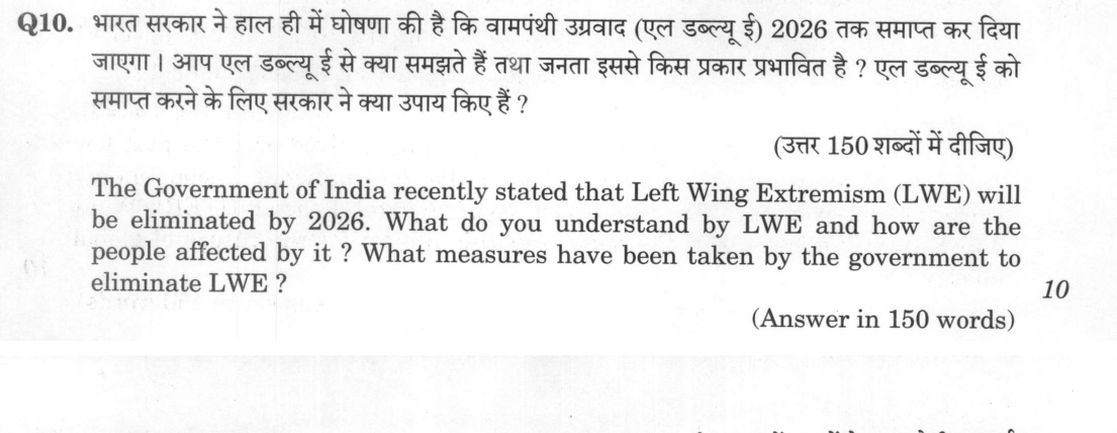
The Government of India recently stated that Left Wing Extremism (LWE) will be eliminated by 2026. What do you understand by LWE and how are the people affected by it ? What measures have been taken by the government to eliminate LWE ? (Answer in 150 words) 10 marks
हिंदी में प्रश्न पढ़ें
भारत सरकार ने हाल ही में घोषणा की है कि वामपंथी उग्रवाद (एल डब्ल्यू ई) 2026 तक समाप्त कर दिया जाएगा। आप एल डब्ल्यू ई से क्या समझते हैं तथा जनता इससे किस प्रकार प्रभावित है ? एल डब्ल्यू ई को समाप्त करने के लिए सरकार ने क्या उपाय किए हैं ? (उत्तर 150 शब्दों में दीजिए)
Model answer
Written by UPSC Answer Check against this question's marking rubric, to the 150-word length. UPSC does not publish answers for Mains — this is one way to score well, not an official key.
Left Wing Extremism (LWE) refers to an armed Maoist insurgency operating across the 'Red Corridor' (states like Chhattisgarh, Jharkhand, and Odisha) seeking to overthrow the constitutional state through violent revolution.
Impact on People: LWE causes civilian casualties, extortion, forced displacement, and coercive recruitment of tribal youth. By deliberately targeting schools, roads, and healthcare centres, extremists deny basic public services and perpetuate severe socio-economic underdevelopment in tribal belts.
Government Measures: Security Framework: Implementation of the holistic SAMADHAN doctrine, Operation Green Hunt, joint CAPF deployments, and surrender-cum-rehabilitation policies, which reduced LWE-affected districts to around 90 by 2023. Developmental Interventions: Road Connectivity Project for LWE Areas (RCPLWE), installation of telecom mobile towers, establishing Eklavya Model Residential Schools, PMGAY housing, and focused development through the Aspirational Districts Programme.
Consequently, violent incidents declined from 1,814 in 2010 to around 500 in 2023. However, achieving the 2026 elimination target requires complementing security operations with resolving structural issues, notably tribal land alienation, Forest Rights Act implementation gaps, and governance deficits.
What "Explain" is asking you to do
Make the working of something clear — what sets it off, what follows from what, and what it produces. Explain is the Commission's mechanism word: it dominates the technical papers and the “explain why” stems, where the marks sit in the causal chain and not in the label.
Structure that answers it
State what it is → the initiating condition → the chain of cause, step by step → an instance where it plays out → what the chain produces
Where marks are lost
Describing what something looks like instead of why it works that way. Naming the stages without linking them reads as description too.
How this answer will be evaluated
Approach
Framework: Security: classify threat, vulnerability, response; stay calm. explain: definition/context > points in order > small example > short close Full marks: Precise definition, clear impact analysis, specific legal and developmental measures cited.
Key points expected
- Define LWE as Naxalism/Maoism
- Explain impact on people (displacement, violence)
- List legal measures (UAPA, AFSPA)
- List developmental measures (infrastructure, connectivity)
Evaluation rubric
Each sub-part is marked on its own, against the marks and word limit printed on the paper.
- The answer Define LWE, detail its impact on people, and list government measures for elimination. 10 marks · 150 words
explain— definition/context → points in order → small example → short close
Must cover
- Define LWE as Naxalism/Maoism
- Explain impact on people (displacement, violence)
- List legal measures (UAPA, AFSPA)
- List developmental measures (infrastructure, connectivity)
Loses marks
- Dramatic or emotional security writing
- Vague generalities without specific measures
- Ignoring the 'impact on people' aspect
Earns more
- Mention specific schemes (e.g., PM Gati Shakti)
- Reference specific states (e.g., Chhattisgarh, Jharkhand)
- Mention institutional measures (e.g., DRI, CAPF)
Extra mark
- Cite specific statistic on LWE affected districts
- Mention specific committee (e.g., K. Chandrashekhar)
Practice this exact question
Write your answer and it is marked point by point against the model answer above — what you covered, what you missed, what you got wrong.
Evaluate my answer →More from General Studies 2025 GS Paper III
- Q7 What is Carbon Capture, Utilization and Storage (CCUS) ? What is the potential role of CC…
- Q8 Seawater intrusion in the coastal aquifers is a major concern in India. What are the caus…
- Q9 Terrorism is a global scourge. How has it manifested in India ? Elaborate with contempora…
- Q10 The Government of India recently stated that Left Wing Extremism (LWE) will be eliminated…
- Q11 Explain how the Fiscal Health Index (FHI) can be used as a tool for assessing the fiscal…
- Q12 Discuss the rationale of the Production Linked Incentive (PLI) scheme. What are its achie…
- Q13 Examine the factors responsible for depleting groundwater in India. What are the steps ta…