GS Paper III — Q8
Seawater intrusion in the coastal aquifers is a major concern in India. What are the causes of seawater intrusion and the…
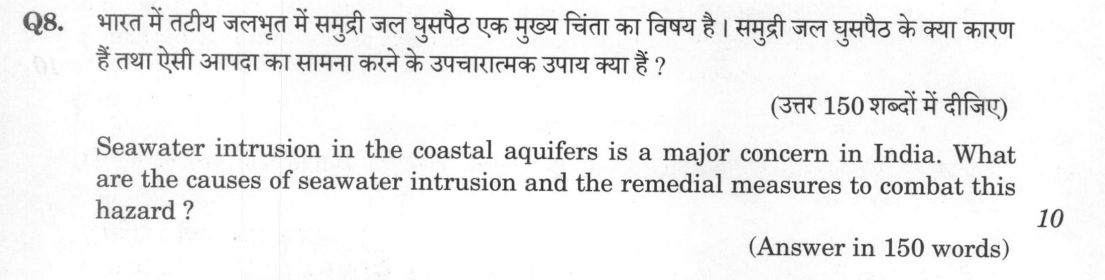
Seawater intrusion in the coastal aquifers is a major concern in India. What are the causes of seawater intrusion and the remedial measures to combat this hazard ? (Answer in 150 words) 10 marks
हिंदी में प्रश्न पढ़ें
भारत में तटीय जलभृत में समुद्री जल घुसपैठ एक मुख्य चिंता का विषय है। समुद्री जल घुसपैठ के क्या कारण हैं तथा ऐसी आपदा का सामना करने के उपचारात्मक उपाय क्या हैं ? (उत्तर 150 शब्दों में दीजिए)
Model answer
Written by UPSC Answer Check against this question's marking rubric, to the 150-word length. UPSC does not publish answers for Mains — this is one way to score well, not an official key.
Seawater intrusion is the landward migration of saline water into freshwater coastal aquifers, degrading water quality and threatening coastal ecosystems.
Causes of Intrusion
- Natural Causes: Sea level rise driven by climate change, tidal effects, storm surges during cyclones, and reduced freshwater discharge from rivers that lowers downstream hydraulic pressure.
- Anthropogenic Causes: Excessive groundwater extraction for agriculture and industry, diminished natural recharge caused by rapid urbanization, and the deforestation of protective mangroves along coastlines.
Remedial Measures
- Physical Barriers: Constructing subsurface dams, installing freshwater injection wells to create hydraulic ridges, and trenching with impermeable materials to block saline ingress.
- Management Measures: Regulated groundwater abstraction, scaling up artificial recharge structures, mandatory rainwater harvesting, and intensive coastal aquifer monitoring.
- Policy Interventions: Strict enforcement of Coastal Regulation Zone (CRZ) norms, achieving National Water Mission objectives, and instituting community-based coastal aquifer management.
Integrating structural engineering with participatory governance ensures sustainable groundwater management in India's vulnerable coastal belts.
What "What" is asking you to do
What is an interrogative rather than a command word. It opens a multi-part stem — what the thing is, then its causes, risks or remedies — and the definitional clause is the gate rather than the answer, with the marks spread across the clauses that follow it.
Structure that answers it
What it is, in two or three lines → the second clause of the stem, at length → the third clause, at length → a closing line only if room remains
Where marks are lost
Spending half the answer establishing the object and leaving the later clauses, which carry most of the marks, thinly answered.
How this answer will be evaluated
Approach
Framework: Environment: threat, causes, impact, mitigation. explain: definition/context > points in order > small example > short close Full marks: Precise technical causes (over-pumping, sea-level rise) and specific, implementable remedial measures (barriers, MAR).
Key points expected
- Identify over-exploitation of groundwater as primary cause
- Mention sea-level rise or coastal erosion
- Suggest artificial recharge or rainwater harvesting
- Mention construction of barriers or desalination
Evaluation rubric
Each sub-part is marked on its own, against the marks and word limit printed on the paper.
- The answer Define the phenomenon and list causes and remedial measures. 10 marks · 150 words
explain— definition/context → points in order → small example → short close
Must cover
- Identify over-exploitation of groundwater as primary cause
- Mention sea-level rise or coastal erosion
- Suggest artificial recharge or rainwater harvesting
- Mention construction of barriers or desalination
Loses marks
- Vague generalities without specific technical terms
- Ignoring the 'coastal' aspect of the problem
- Listing only causes without remedial measures
Earns more
- Reference to specific coastal states (e.g., Tamil Nadu, Gujarat)
- Mention of 'freshwater-saltwater interface' concept
- Reference to National Water Policy or CWC guidelines
- Mention of 'managed aquifer recharge' (MAR)
Extra mark
- Reference to specific scheme (e.g., Jal Jeevan Mission)
- Simple diagram of intrusion mechanism
Practice this exact question
Write your answer and it is marked point by point against the model answer above — what you covered, what you missed, what you got wrong.
Evaluate my answer →More from General Studies 2025 GS Paper III
- Q5 The fusion energy programme in India has steadily evolved over the past few decades. Ment…
- Q6 How can India achieve energy independence through clean technology by 2047 ? How can biot…
- Q7 What is Carbon Capture, Utilization and Storage (CCUS) ? What is the potential role of CC…
- Q8 Seawater intrusion in the coastal aquifers is a major concern in India. What are the caus…
- Q9 Terrorism is a global scourge. How has it manifested in India ? Elaborate with contempora…
- Q10 The Government of India recently stated that Left Wing Extremism (LWE) will be eliminated…
- Q11 Explain how the Fiscal Health Index (FHI) can be used as a tool for assessing the fiscal…