GS Paper III — Q6
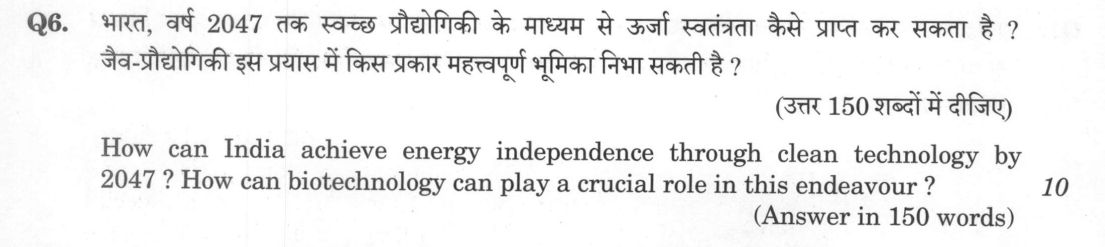
How can India achieve energy independence through clean technology by 2047 ? How can biotechnology can play a crucial role in…
How can India achieve energy independence through clean technology by 2047 ? How can biotechnology can play a crucial role in this endeavour ? (Answer in 150 words) 10 marks
हिंदी में प्रश्न पढ़ें
भारत, वर्ष 2047 तक स्वच्छ प्रौद्योगिकी के माध्यम से ऊर्जा स्वतंत्रता कैसे प्राप्त कर सकता है ? जैव-प्रौद्योगिकी इस प्रयास में किस प्रकार महत्वपूर्ण भूमिका निभा सकती है ? (उत्तर 150 शब्दों में दीजिए)
Model answer
Written by UPSC Answer Check against this question's marking rubric, to the 150-word length. UPSC does not publish answers for Mains — this is one way to score well, not an official key.
India can transition from its heavy crude import dependence to energy independence by 2047 through a two-pronged strategy:
Clean Technology Pathways: Scaling non-fossil capacity to 500 GW by 2030, deploying the National Green Hydrogen Mission for industrial decarbonisation, and integrating grid-scale battery and pumped-hydro energy storage solutions.
Biotechnology Interventions: Advanced Biofuels: Scaling second-generation (2G) bioethanol from agricultural residue, biodiesel from non-edible seeds (Jatropha, Karanja), and exploring algal biofuels to achieve the National Biofuel Policy’s E20 blending targets. Bio-refineries and Circular Economy: Establishing integrated bio-refineries, waste-to-energy plants under the SATAT scheme for compressed bio-gas, and developing microbial fuel cells. R&D in Synthetic Biology: Engineering microbial strains and enzymes to overcome feedstock recalcitrance, improving cost competitiveness and conversion efficiency.
Accelerating clean technology alongside biotechnology will slash India's import bills, foster rural employment, and secure energy sovereignty for Amrit Kaal 2047.
What "How" is asking you to do
Set out the route by which the outcome comes about, step by step. Many how stems ask how one thing affects another, and there the channel of transmission is precisely what is being marked.
Structure that answers it
Starting condition → step → step → outcome reached → the conditions the route depends on
Where marks are lost
Answering why it happens instead of how, the commonest single misread in the paper. An answer full of causes and significance that never traces the mechanism has answered a different question.
How this answer will be evaluated
Approach
Framework: GS3 Technology & Environment. explain: definition/context > points in order > small example > short close Full marks: Links specific biotech (algae/ethanol) to 2047 grid/transport targets.
Key points expected
- Renewable energy mix (solar/wind) for grid stability
- Biofuels (ethanol) for transport sector substitution
- Algae-based bioenergy or waste-to-energy conversion
- Policy framework (e.g., National Biofuel Policy)
Evaluation rubric
Each sub-part is marked on its own, against the marks and word limit printed on the paper.
- The answer Mechanism of clean tech for 2047 independence and specific biotech applications. 10 marks · 150 words
explain— definition/context → points in order → small example → short close
Must cover
- Renewable energy mix (solar/wind) for grid stability
- Biofuels (ethanol) for transport sector substitution
- Algae-based bioenergy or waste-to-energy conversion
- Policy framework (e.g., National Biofuel Policy)
Loses marks
- Generic 'clean energy' without specific tech names
- Ignoring the biotechnology component of the question
- Aspirational writing without implementable measures
Earns more
- Mention of Green Hydrogen as a clean vector
- Reference to 'Viksit Bharat' 2047 vision
- Linkage of biotech to circular economy
- Specific mention of 2G ethanol feedstocks
Extra mark
- Citing specific 2047 target figures (e.g., 50% RE)
- Mentioning specific biotech startups or R&D centers
Practice this exact question
Write your answer and it is marked point by point against the model answer above — what you covered, what you missed, what you got wrong.
Evaluate my answer →More from General Studies 2025 GS Paper III
- Q3 Explain the factors influencing the decision of the farmers on the selection of high valu…
- Q4 Elaborate the scope and significance of supply chain management of agricultural commoditi…
- Q5 The fusion energy programme in India has steadily evolved over the past few decades. Ment…
- Q6 How can India achieve energy independence through clean technology by 2047 ? How can biot…
- Q7 What is Carbon Capture, Utilization and Storage (CCUS) ? What is the potential role of CC…
- Q8 Seawater intrusion in the coastal aquifers is a major concern in India. What are the caus…
- Q9 Terrorism is a global scourge. How has it manifested in India ? Elaborate with contempora…