GS Paper III — Q14
Examine the scope of the food processing industries in India. Elaborate the measures taken by the government in the food…
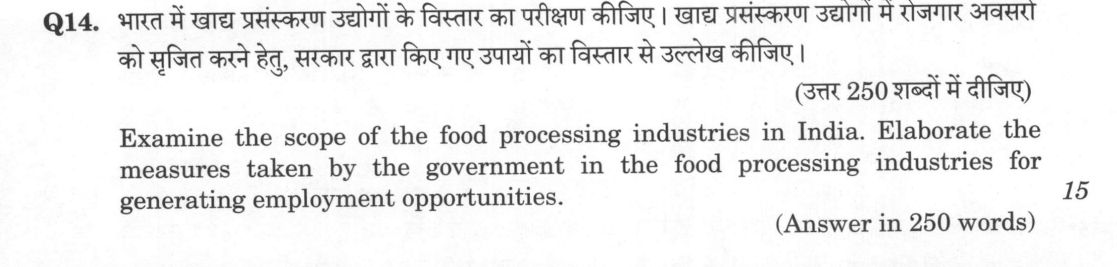
Examine the scope of the food processing industries in India. Elaborate the measures taken by the government in the food processing industries for generating employment opportunities. (Answer in 250 words) 15 marks
हिंदी में प्रश्न पढ़ें
भारत में खाद्य प्रसंस्करण उद्योगों के विस्तार का परीक्षण कीजिए। खाद्य प्रसंस्करण उद्योगों में रोजगार अवसरों को सृजित करने हेतु, सरकार द्वारा किए गए उपायों का विस्तार से उल्लेख कीजिए। (उत्तर 250 शब्दों में दीजिए)
Model answer
Written by UPSC Answer Check against this question's marking rubric, to the 250-word length. UPSC does not publish answers for Mains — this is one way to score well, not an official key.
India’s food processing sector has large scope because the country is the world’s largest producer of milk and pulses and second largest in fruits and vegetables, yet only about 10% of produce is processed, against roughly 80% in developed economies. This gap shows that value addition, export potential and supply-chain integration can convert perishable farm output into higher-value products, reduce wastage and create stable urban-rural linkages. It can also strengthen export competitiveness of dairy, spices and processed foods. The employment multiplier is significant: each direct job can generate about 2.5 indirect jobs, with special relevance for rural women and youth who can participate in collection, cleaning, packaging, quality control and marketing.
Government measures are aimed at formalisation, scale and infrastructure. The PM Formalisation of Micro Food Processing Enterprises (PMFME) Scheme targets 2 lakh micro enterprises through credit-linked subsidy and FPO integration, enabling small processors to access markets and create local jobs. The Production Linked Incentive (PLI) Scheme for Food Processing, with an outlay of ₹10,900 crore, seeks to expand large-scale processing and is expected to generate about 2.5 lakh direct and 7.5 lakh indirect jobs. SAMPADA-linked Mega Food Parks and Integrated Cold Chain schemes provide backward/tribal-area infrastructure, reducing post-harvest losses and enabling processing clusters.
However, employment gains remain constrained by fragmented supply chains, seasonality, skill gaps and weak value-chain coordination. The sector’s potential will be realised only when subsidies shift from inputs to processing, cold storage, quality standards and FPO-led aggregation, making food processing a durable engine of rural employment.
What "Examine" is asking you to do
Test the proposition the question puts to you and return a finding on how far it holds. Examine stems carry a claim, or ask whether something has happened, and expect evidence weighed both ways before the extent is stated — often with remedial measures attached.
Structure that answers it
Restate the claim as the question frames it → evidence that supports it → evidence that undercuts it → the conditions under which it holds → verdict on how far it stands
Where marks are lost
Stopping at description. An examination has to reach a finding, and “examine with justification” means the extent must be stated, not implied.
How this answer will be evaluated
Approach
Framework: Situation > Analysis > Measures: legal, institutional, developmental > Assessment. examine: intro > how/why with reasoning > evidence > conclusion Full marks: Detailed scope with data; specific schemes (PMFME) linked to employment.
Key points expected
- Scope: value addition to raw agri produce
- Scope: export potential and import substitution
- Measures: specific schemes (e.g., PMFME, MTPS)
- Measures: institutional support (NHB, FSSAI)
Evaluation rubric
Each sub-part is marked on its own, against the marks and word limit printed on the paper.
- The answer Assess the potential of the food processing sector and detail government employment measures. · 250 words
examine— intro → how/why with reasoning → evidence → conclusion
Must cover
- Scope: value addition to raw agri produce
- Scope: export potential and import substitution
- Measures: specific schemes (e.g., PMFME, MTPS)
- Measures: institutional support (NHB, FSSAI)
Loses marks
- Generic 'government support' without naming schemes
- Ignoring the employment aspect of measures
- Aspirational writing without implementable details
Earns more
- Mention of specific sub-sectors (dairy, fruits)
- Linkage to rural employment generation
- Reference to infrastructure development (cold chain)
- Mention of FSSAI for quality standards
Extra mark
- Specific budget allocation figure for PMFME
- Simple flowchart of value chain
Practice this exact question
Write your answer and it is marked point by point against the model answer above — what you covered, what you missed, what you got wrong.
Evaluate my answer →More from General Studies 2025 GS Paper III
- Q11 Explain how the Fiscal Health Index (FHI) can be used as a tool for assessing the fiscal…
- Q12 Discuss the rationale of the Production Linked Incentive (PLI) scheme. What are its achie…
- Q13 Examine the factors responsible for depleting groundwater in India. What are the steps ta…
- Q14 Examine the scope of the food processing industries in India. Elaborate the measures take…
- Q15 How does nanotechnology offer significant advancements in the field of agriculture ? How…
- Q16 India aims to become a semiconductor manufacturing hub. What are the challenges faced by…
- Q17 Mineral resources are fundamental to the country's economy and these are exploited by min…